Assyrian Forums
 Home  |  Ads  |  Partners  |  Sponsors  |  Contact  |  FAQs  |  About  
 
   Holocaust  |  History  |  Library  |  People  |  TV-Radio  |  Forums  |  Community  |  Directory
  
   General  |  Activism  |  Arts  |  Education  |  Family  |  Financial  |  Government  |  Health  |  History  |  News  |  Religion  |  Science  |  Sports
   Greetings · Shläma · Bärev Dzez · Säludos · Grüße · Shälom · Χαιρετισμοί · Приветствия · 问候 · Bonjour · 挨拶 · تبریکات  · Selamlar · अभिवादन · Groete · التّحيّات

Luke 8:27 deadly spear in the Greek Dragon

Archived: Read only    Previous Topic Next Topic
Home Forums Peshitta Topic #837
Help Print Share
James_Trimm
 
Send email to James_TrimmSend private message to James_TrimmAdd James_Trimm to your contact list
 
Member:
Member Feedback

Luke 8:27 deadly spear in the Greek Dragon

Jan-28-2002 at 08:52 AM (UTC+3 Nineveh, Assyria)


8:27 And when he had disembarked onto land, he met one man from the province in whom a devil had been for a long time. And he did not wear clothes and did not dwell in a house but in the tombs.

province Aramaic: 0tnydm This is an ambiguous Aramaic word. Normally this word means city (as in the Talmud b.Taanit 19b & 21a)) as the Greek translator rendered it but in the Jewish Aramaic dialects it can also be used to mean province (as in the Talmud b.Meg. 13b & b.San. 92b). There are several clues that the word here means province and not city. The man did not dwell in a house but in the tombs because he had been driven into the wilderness (8:29). Anyone familiar with Jewish Law will quickly realize that tombs are ritually unclean were not found in the city. The fact that the man dwelt among them was intended to testify to the totality of his ritually impure state. Moreover an examination of the parallel synoptic accounts (Mt. 8:28 & Mk. 5:2) reveals that the true meaning of 0tnydm in this passage is province and the Greek translator mistranslated it as city.

Now as far as I know (and Paul correct me if I am wrong) this word always means "city" in the Syriac dialect. This makes this piece of evidence an especially deep spear! It points to the author of the Aramaic of Luke as expressed in the Peshitta (and/or Old Syriac in this case)
as being of Jewish origin and NOT just a Syrian/Assyrian composition! It lends great credibility to the idea that the text was BROUGHT to the Parthean Empire by the original Jewish followers of Yeshua!

Any thoughts?

Trimm

Print Top

 
Forums Topics  Previous Topic Next Topic

Paul Younanmoderator

 
Send email to Paul YounanSend private message to Paul YounanView profile of Paul YounanAdd Paul Younan to your contact list
 
Member: Jun-1-2000
Posts: 1,306
Member Feedback

1. RE: Luke 8:27 deadly spear in the Greek Dragon

Jan-28-2002 at 09:57 AM (UTC+3 Nineveh, Assyria)

In reply to message #0
 
Last edited by Paul Younan on Jan-28-2002 at 10:36 AM (CT)

Shlama James,

Three things - Number one - it is more correct to translate "province" in Luke 8:27 instead of "city."

Number two - a little background for the people here on what you call "Syriac" (a Greek name for "Christian Aramaic.") "Syriac" (or, as we who speak it call it - "Aramaic") is no more or less Aramaic than the language of the Imperial empires of Assyria, Babylon and Persia - my ancestors. It is no more or less Aramaic than the language spoken by the Chaldean Babylonian Aramean Patriarchs Abraham, Isaac and Israel. It is no more or less Aramaic than the language of Palmyra, Hatra, Damascus, Babylon, Nineveh or the language of the Targums. It is no more or less Aramaic than the language of portions of Daniel.

It's a specific dialect which had wide usage at that time ranging from Babylon and Edessa all the way to Galilee and Jerusalem.

The language of the 22 New Testament books that were later called "Peshitta" is in this dialect that you term "Syriac", but which is a term that is offensive to me since it's a Greek term and we don't like to call our language by foreign terms.

I said all that to say this - the entire Peshitta is written in this dialect you call "Syriac" - therefore, if Mdintha is used in a primary text of what you call "Syriac" to mean province - then that should answer your question about how Mdintha is used in "Syriac."

Number three - all four of my grandparents emigrated here from Mdintha d'Hakkari - a map of which you can view here:
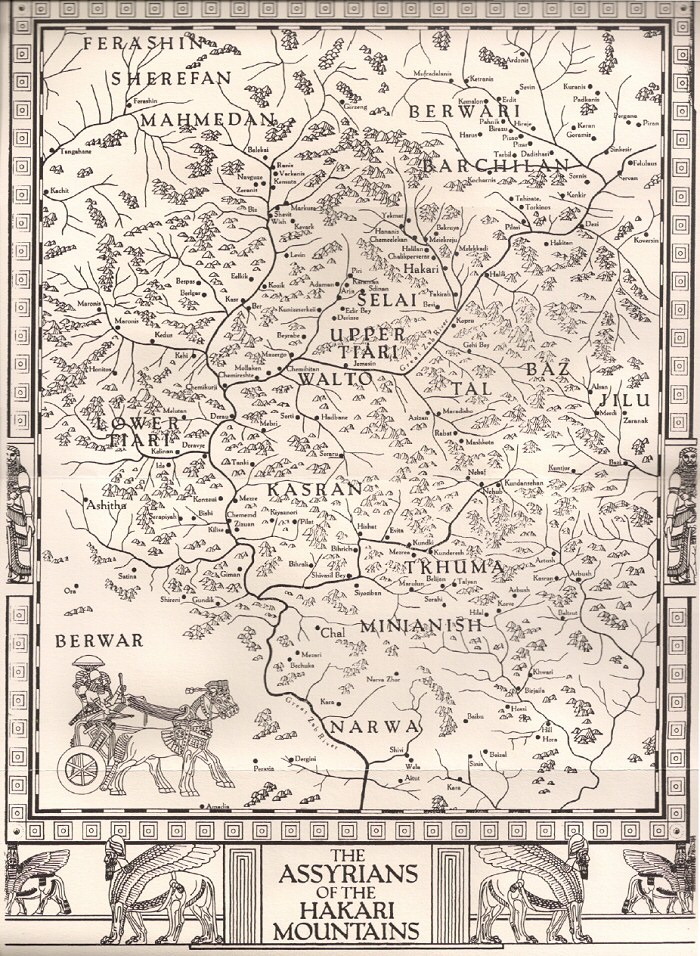
If you look at the map closely - you can see the name of the major city of the province, Hakkari - situated just to the top and right of the area called Selai.

As you can see - not only does Mdintha in our "Syriac" (as the Greeks call it) dialect mean "province" - it also is applied to areas of an entire mountain range in modern-day Turkey of which the main "city" is called Hakkari.

The best English translation of the Aramaic Mdintha is the general term - "area."

Incidentally, if anyone's interested - Mdintha in the Arabic language is pronounced "Medina" (as in "Mecca and Medina.")

Fk^rwbw 0ml4

Peshitta.org

Print Top

Paul Younanmoderator

 
Send email to Paul YounanSend private message to Paul YounanView profile of Paul YounanAdd Paul Younan to your contact list
 
Member: Jun-1-2000
Posts: 1,306
Member Feedback

2. RE: Luke 8:27 deadly spear in the Greek Dragon

Jan-28-2002 at 10:45 AM (UTC+3 Nineveh, Assyria)

In reply to message #1
 
Oh yes - I do agree that this is a deadly spear in the Greek dragon. :c

Fk^rwbw 0ml4

Peshitta.org

Print Top
Biga
 
Send email to BigaSend private message to BigaView profile of BigaAdd Biga to your contact list
 
Member:
Posts: 193
Member Feedback

3. RE: Luke 8:27 deadly spear in the Greek Dragon

Jan-29-2002 at 09:27 AM (UTC+3 Nineveh, Assyria)

In reply to message #0
 
Akhi James,

my translation does not write "from city", but "from the course of the city". So they can live out of city in the tombs. The context is the verse speak about witnesses, people and about a city, where the healed published the great things throughout the whole city. It seems for me, it is certain that there was a near city. What is your opinion?

Print Top

Forums Topics  Previous Topic Next Topic


Assyria \ã-'sir-é-ä\ n (1998)   1:  an ancient empire of Ashur   2:  a democratic state in Bet-Nahren, Assyria (northern Iraq, northwestern Iran, southeastern Turkey and eastern Syria.)   3:  a democratic state that fosters the social and political rights to all of its inhabitants irrespective of their religion, race, or gender   4:  a democratic state that believes in the freedom of religion, conscience, language, education and culture in faithfulness to the principles of the United Nations Charter — Atour synonym

Ethnicity, Religion, Language
» Israeli, Jewish, Hebrew
» Assyrian, Christian, Aramaic
» Saudi Arabian, Muslim, Arabic
Assyrian \ã-'sir-é-an\ adj or n (1998)   1:  descendants of the ancient empire of Ashur   2:  the Assyrians, although representing but one single nation as the direct heirs of the ancient Assyrian Empire, are now doctrinally divided, inter sese, into five principle ecclesiastically designated religious sects with their corresponding hierarchies and distinct church governments, namely, Church of the East, Chaldean, Maronite, Syriac Orthodox and Syriac Catholic.  These formal divisions had their origin in the 5th century of the Christian Era.  No one can coherently understand the Assyrians as a whole until he can distinguish that which is religion or church from that which is nation -- a matter which is particularly difficult for the people from the western world to understand; for in the East, by force of circumstances beyond their control, religion has been made, from time immemorial, virtually into a criterion of nationality.   3:  the Assyrians have been referred to as Aramaean, Aramaye, Ashuraya, Ashureen, Ashuri, Ashuroyo, Assyrio-Chaldean, Aturaya, Chaldean, Chaldo, ChaldoAssyrian, ChaldoAssyrio, Jacobite, Kaldany, Kaldu, Kasdu, Malabar, Maronite, Maronaya, Nestorian, Nestornaye, Oromoye, Suraya, Syriac, Syrian, Syriani, Suryoye, Suryoyo and Telkeffee. — Assyrianism verb

Aramaic \ar-é-'máik\ n (1998)   1:  a Semitic language which became the lingua franca of the Middle East during the ancient Assyrian empire.   2:  has been referred to as Neo-Aramaic, Neo-Syriac, Classical Syriac, Syriac, Suryoyo, Swadaya and Turoyo.

Please consider the environment when disposing of this material — read, reuse, recycle. ♻
AIM | Atour: The State of Assyria | Terms of Service
