USA, Washington DC: Assyrian Legacy:
|

|
|
Assyrian Legacy
|
Contents
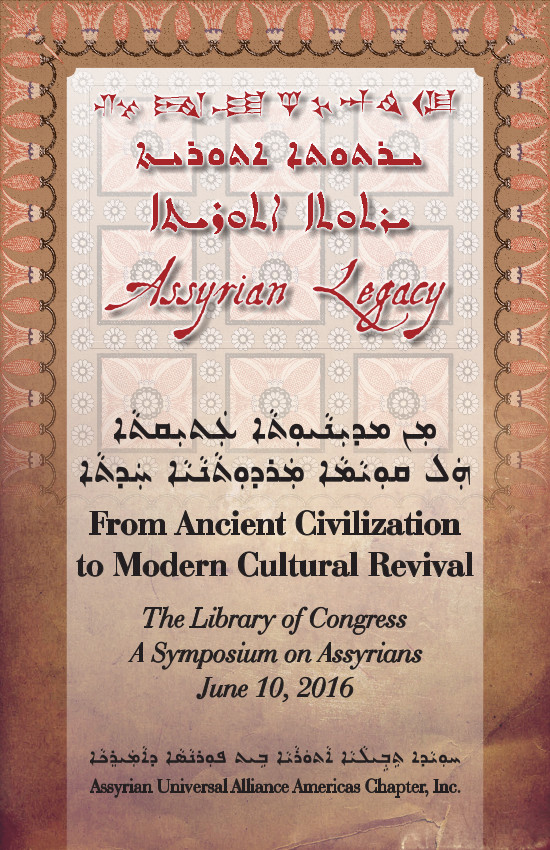
Assyrian Legacy
From Ancient Civilization to Today’s Culture Revival
Friday, June 10, 2016
8:30am – 3:30pm
Room LJ-119
First Floor, Thomas Jefferson Building
10 First St. SE
Washington, DC 20540 USA
Book Display in Room LJ-113
Welcoming Remarks
- Dr Mary-Jane Deeb, Chief, The African and Middle Eastern Division at the Library of Congress.
Session I: The Assyrian Legacy in the Cradle of Civilization
- Prof. Amir Harrak, Empire Art and Culture Overview.
- Prof. Christopher E. Woods, Associate Professor of Sumerology, Editor Journal of Near Eastern Studies The Oriental Institute The University of Chicago
- Prof. Simo Parpola (Helsinki University) Statecraft models for the ancient world.
Session II: The Assyrian Christian Past and Present
- Dr. Mark Dickens (University of Alberta) Adoption of Christianity and Its spread along the Silk Road.
- Prof. Jonathan Loopstra (Capital University Ohio) The Route of Transmission of Ancient Knowledge- Syriac as Historians’ Resource.
- TBD-The Tradition of Syriac Sacred music, its preservation and Dissemination.
Session III: Assyrian Culture in the Middle East and in Diaspora
- Dr. Fadi Davood, PHD (University of Toronto, Toronto) Of Patriarchates and their place in Assyrian Identity.
- Dr. Alda Benjamin, PHD (University of Maryland, Washington DC) Assyrian intellectual narratives in urban Iraqi centers during the 1970s.
- Dr. Eden Naby, PHD (Independent Scholar, Cambridge, MA): Art and Literature of Assyrians in Survival Mode or Preservation of Aramaic through word and music.
Live Music: Ms. Tabeetha Adde, Vocals - Mr. Andrew Bet-Shlemon, Oud.
If you would like to support AUA Americas’ initiatives
click on the link below to make a donation.
Assyrian Universal Alliance — Americas Chapter, Inc. (AUA Americas)
125 East Campbell Ave.
Campbell, California 95008 USA
Phone: 1-408-892-5914 | Fax: 1-408-369-0186 | Email: aua [ a t ] aua.net
125 East Campbell Ave.
Campbell, California 95008 USA
Phone: 1-408-892-5914 | Fax: 1-408-369-0186 | Email: aua [ a t ] aua.net
Press contact: Audrey Fischer (202) 707-0022
Public contact: Mary-Jane Deeb (202) 707-1221
Request ADA accommodations five business days in advance
at (202) 707-6362 or ada [ a t ] loc.gov
at (202) 707-6362 or ada [ a t ] loc.gov
The African and Middle Eastern Division in the Library of Congress, in cooperation with the Assyrian Universal Alliance-America, will present a symposium on the ancient Assyrian civilization and its contemporary manifestation.
June 1, 2016
Ancient Assyrian Legacy Subject of June Symposium
The African and Middle Eastern Division in the Library of Congress, in cooperation with the Assyrian Universal Alliance-America, will present a symposium on the ancient Assyrian civilization and its contemporary manifestation.
"The Assyrian Legacy: From Ancient Civilization to Today's Cultural Revival," a free symposium open to the public, will be held from 8:30 a.m. to 3:30 p.m. on Friday, June 10, in Room 119 of the Thomas Jefferson Building, located at 10 First Street S.E., Washington D.C. Tickets are not required.
According to one interpretation based on the Book of Genesis in the Bible, Genesis 10:22, the founder of the Assyrians was Ashur, son of Shem and grandson of Noah, who, after the Great Flood, went off to build a city named for him, located northeast of Babylon.
Archaeological excavations show that a city existed as early as the third millennium B.C., on the site on which the city of Ashur was built in Mesopotamia around 1900 B.C.. By the second millennium B.C., the Assyrian empire had grown and spread from Mesopotamia in the east to Asia Minor in the north and to Egypt in the south. Assyrian cities became prosperous commercial centers that traded with Anatolia and the Near East and perfected the craft of iron-work.
The Assyrians were a Semitic people who originally spoke Akkadian. Sometime in the first millennium they shifted to Aramaic, which was the dominant language of the Near East. The language has survived to the present day in the liturgy of Eastern Christians and in the Jewish marriage certificates, or "ketubahs." The Library of Congress holds both Christian liturgical textbooks and ketubahs in that ancient script. Syriac, a dialect of Aramaic, is still the language of the Assyrians today.
"This is the Library's first major conference on the rich history of the Assyrians and their contribution to world civilization," said Mary-Jane Deeb, chief of the African and Middle Eastern Division, who will moderate one of the three panels along with Levon Avdoyan, the Library's Armenian and Georgian specialist, and Muhannad Salhi, the Library's Arab world area specialist. There will also be a display of books in many different languages on and about Assyrian history, culture, music and archaeology.
Panel One will focus on the ancient history and culture of the Assyrians and the Gilgamesh epic, with presentations by Amir Harrak, associate professor in the University of Toronto's Department of Near and Middle Eastern Civilizations; Christopher Woods, associate professor of Sumerian at the Oriental Institute of the University of Chicago; and Simo Parpola, professor emeritus of Assyriology at the University of Helsinki.
Panel Two will be on the history of Christianity among the Assyrians, and will include presentations by Mark Dickens, adjunct professor of history and classics at the University of Alberta, Canada; Jonathan Loopstra, assistant professor of ancient history and digital humanities at the University of Northwestern-St. Paul; and Tala Jarjour, assistant professor of ethnomusicology at the University of Notre Dame.
Panel Three will focus on the Assyrian culture in the Middle East and the diaspora. The presenters will include Fadi Davood, a lecturer at the University of Lakehead in Ontario, Canada; Alda Benjamin, a postdoctoral researcher at the Cultural Heritage Center of the University of Pennsylvania Museum and a research associate at the Smithsonian Institution; and Eden Naby, a contributing editor on modern Assyrians for the "Encyclopædia Iranica."
Founded in 1800, the Library of Congress is the world's largest library. The Library seeks to spark imagination and creativity and to further human understanding and wisdom by providing access to knowledge through its magnificent collections, programs, publications and exhibitions. Many of the Library's rich resources can be accessed through its website at loc.gov.
The Library's African and Middle Eastern Division is the center for the study of 78 countries and regions from Southern Africa to the Maghreb and from the Middle East and the Caucasus to Central Asia. For more information, visit loc.gov/rr/amed/.
The Assyrian Universal Alliance was founded in 1968 as an umbrella organization for a number of Assyrian federations and organizations worldwide, which seek to spread knowledge and information about Assyrians and their contribution to world civilization and to secure their human rights wherever they live.
# # #
PR 16-098
06/01/16
ISSN 0731-3527
 Assyrian Forums
 Assyrian Community Calendar