
 Related Information
 London Times News Articles
| List of targeted villages [10] | |||||||||||||
| Ala Keena | Bameri | Betershy | Dairke | Gond Naze | Kaserezden | Korekavana | Majel Makhte | Sirchuri | |||||
| Aloka | Barcawra | Betafrey | Dair Kishnik | Harkonda | Kerry | Kowashey | Rabibyia | Shekhidra | |||||
| Badalliya | Baroshkey | Bidari | Derjendy | Idleb | Kitba | Lazga | Rekawa | Spendarook | |||||
| Baderden | Basorik | Biswaya | Fishkhabour | Kaberto | Khalata | Mansouriya | Sar Shorey | Tal Zet | |||||
| Bagerey | Bastikey | Carbeli | Garvaly | Karpel | Kharab Koli | Mawani | Sezary | Tel Khish | |||||
| Bakhitmey | Benaringee | Chem Jehaney | Gereban | Karshen | Kharsheniya | Qasr Yazdin | Sidzari | Zeniyat | |||||
|
1933: The Simele Genocide
 |
||||
|
Posted: Sunday, April 05, 2009 at 12:05 PM CT
The Simele Genocide
(Syriac: ܦܪܡܬܐ ܕܣܡܠܐ: Premta d-Simele) was the first of many massacres committed by the Iraqi government during the systematic targeting of Assyrians of Northern Iraq in August 1933. The term is used to describe not only the massacre of Simele, but also the killing spree that continued among 63 Assyrian villages in the Dohuk and Mosul districts that led to the deaths of an estimated 3,000 innocent Assyrians.[1][2] The Assyrian people at the time were emerging from one of the darkest periods of their history the Assyrian genocide at the end of the World War I, an estimated two-thirds of their population was massacred by Ottoman Turks and Kurds.[3]
The term 'genocide' was coined by direct influence of this massacre. [4]
Iraqi independence and crisis
Throughout the crisis, beginning in the late spring of 1933, the American representative in Iraq, Paul Knabenshue, described public animosity towards the Assyrians was at 'fever heat.' [5] With Iraqi independence, the new Assyrian spiritual-temporal leader, Mar Eshai Shimun XXIII, demanded the Assyrians be given autonomy within Iraq, seeking support from Britain. He pressed his case before the League of Nations in 1932. His followers planned to resign from the Assyrian levies (a levie under the command of the British, that served British interest), and to re-group as a militia and concentrate in the north, creating a de facto Assyrian enclave. In June 1933, the Patriarch was invited to Baghdad for negotiations with Hikmat Sulayman’s government and was detained there after refusing to relinquish temporal authority. Mar Shimun would eventually be exiled to Cyprus, thus forcing the head of the Assyrian Church of the East to be located in Chicago to this day. [6]
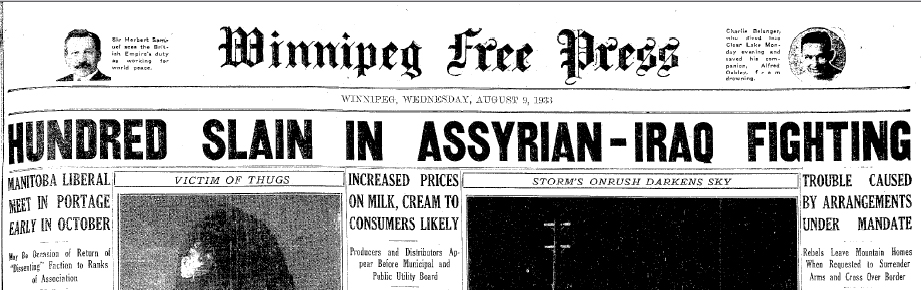
Massacre and looting
In early August 1933, more than 1,000 Assyrians who had been refused asylum in Syria crossed the border to return to their villages in Northern Iraq. The French, who at the time were controlling Syria, had notified the Iraqis that the Assyrians were not armed; but while the Iraqi soldiers were disarming those whose arms had been returned, shots were fired resulting in 30 Iraqi and Assyrian casualties. Anti-Assyrian and Anti-British xenophobia, apparent throughout the crisis, accelerated. [5] Reports circulated of Assyrian mutilation of Iraqi soldiers (later proven to be false). In Baghdad, the government panicked, fearing disaster as the Assyrians presented a formidable fighting force that could provoke a general uprising in the north. The government unleashed Kurdish irregulars who killed some 120 inhabitants of two Assyrian villages in the week of August 2 to August 9 (with most of the massacre occurring on August 7). Then on August 11, Kurdish general Bakr Sidqi (who had clashed with Assyrians before) led a march to what was then one of the most heavily inhabited Assyrian area in Iraq, the Simele district.
.jpg "Simele Genocide - Map - 1933") The Assyrian population of the district of Simele was indiscriminately massacred; men women, and children. In one room alone, eighty one Assyrians of Baz tribe were massacred.[7] Religious leaders were prime targets; eight Assyrian priests were killed during the massacre, including one beheaded and another burned alive. [8] Girls were raped and women violated and made to march naked before the Muslim army commanders.[7] Holy books were used as fuel for burning girls. Children were run over by military cars. Pregnant women were bayoneted. Children were flung in the air and pierced with bayonets.
The Assyrian population of the district of Simele was indiscriminately massacred; men women, and children. In one room alone, eighty one Assyrians of Baz tribe were massacred.[7] Religious leaders were prime targets; eight Assyrian priests were killed during the massacre, including one beheaded and another burned alive. [8] Girls were raped and women violated and made to march naked before the Muslim army commanders.[7] Holy books were used as fuel for burning girls. Children were run over by military cars. Pregnant women were bayoneted. Children were flung in the air and pierced with bayonets.
Back in the city of Dohuk, 600 Assyrians were killed by Sidqi's men.[7]
In the end, around 65 Assyrian villages were targeted in the Mosul and Dohuk districts. [9][10]
The main campaign lasted until August 16, 1933, but violent raids on Assyrians were being reported up to the end of the month. After the campaign, Badr Sidqi was invited to Baghdad for a victory rally. [11] The campaign resulted in one third of the Assyrian population of Iraq fleeing to Syria. [12]
Aftermath
.jpg "Simele Churches") Immediately after the massacre and the shutting down of the Assyrian uprising, the Iraqi government demanded a conscription bill. Non-Assyrian Iraqi tribesmen offered to serve in the Iraqi army, to counter the Assyrians. In late August, the government of Mosul demanded that the central government ‘ruthlessly’ stamp out the rebellion, and that it eliminate all foreign influence in Iraqi affairs, and that the government take immediate steps to enact a law for compulsory military service. The next week, 49 Kurdish tribal chieftains joined in a pro-conscription telegram to the government, expressing thanks for punishing the ‘Assyrian insurgents’[5], stating that a "nation can be proud of itself only through its power, and since evidence of this power is the army,"[5] they requested compulsory military service. Rashid Ali presented the bill to the parliament. His government fell before it was legislated and Jamil Midfai’s government enacted conscription in January 1934. [11]
Immediately after the massacre and the shutting down of the Assyrian uprising, the Iraqi government demanded a conscription bill. Non-Assyrian Iraqi tribesmen offered to serve in the Iraqi army, to counter the Assyrians. In late August, the government of Mosul demanded that the central government ‘ruthlessly’ stamp out the rebellion, and that it eliminate all foreign influence in Iraqi affairs, and that the government take immediate steps to enact a law for compulsory military service. The next week, 49 Kurdish tribal chieftains joined in a pro-conscription telegram to the government, expressing thanks for punishing the ‘Assyrian insurgents’[5], stating that a "nation can be proud of itself only through its power, and since evidence of this power is the army,"[5] they requested compulsory military service. Rashid Ali presented the bill to the parliament. His government fell before it was legislated and Jamil Midfai’s government enacted conscription in January 1934. [11]
From the nationalists’ point of view, the Assyrian levies were British proxies, to be used by their ‘masters’ to destroy the new Iraqi state whose independence the British had consistently opposed. The British allowed their Assyrian auxiliary troops to retain their arms and granted them special duty and privileges: guarding military air installations and receiving higher pay than the Iraqi Arab recruits. Under British protection, the Assyrians did not become Iraqi citizens after independence. The nationalists believed the British were hoping for the Assyrians to destroy Iraq’s internal cohesion by becoming independent and by inciting others such as the Kurds to follow their example.
The massacre would eventually lead to 15,000 Assyrians leaving the Nineveh Plains for neighboring French Mandate of Syria, and create 35 new villages on the banks of the Khabur river.[11]
Cultural impact and legacy
August 7 officially became known as Martyrs Day or National Day of Mourning by the Assyrian community in memory for the Simele massacre, as it was declared so by the Assyrian Universal Alliance in 1970. [13] In 2004, the Syrian government banned an Assyrian political organization from commemorating the event, and threatened arrests if any were to break the ban.[14]
| Shlimon Bet Shmuel: Simele Lyrics: Dinkha Esha |
Many Assyrian music artists such as Shlimon Bet Shmuel have written songs about the event[15]. Thousands of poems and stories have been written about the incident, including one by the Armenian-American William Saroyan, titled "Seventy Thousand Assyrians", written in 1934;
“…We're washed up as a race, we're through, it's all over, why should I learn to read the (Assyrian) language? We have no writers, we have no news — well, there is a little news: once in a while the English encourage the Arabs to massacre us, that is all. It's an old story, we know all about it.” – [16][17]
The Simele massacre inspired Raphael Lemkin to create the concept of "Genocide".[18] In 1933, Lemkin made a presentation to the Legal Council of the League of Nations conference on international criminal law in Madrid, for which he prepared an essay on the Crime of Barbarity as a crime against international law. The concept of the crime, which later evolved into the idea of genocide, was based mostly on the Simele massacre.[19][20]
References
- International Federation for Human Rights — "Displaced persons in Iraqi Kurdistan and Iraqi refugees in Iran", 2003.
- "The Origins and Developments of Assyrian Nationalism", Committee on International Relations Of the University of Chicago, by Robert DeKelaita [1]
- Joseph Yacoub, La question assyro-chaldéenne, les Puissances européennes et la SDN (1908–1938), 4 vol., thèse Lyon, 1985, p. 156.
- Raphael Lemkin - EuropeWorld, 22/6/2001
- Iraq Between the Two World Wars: The Militarist Origins of Tyranny, Reeva S. Simon, 2004.
- Nestorian Patriarchs
- International Journal of Middle East Studies , "The Assyrian Affair of 1933", by Khaldun S. Husry, 1974[2]
- Assyrian International News Agency
- "Modern Aramaic Dictionary & Phrasebook" By Nicholas Awde. Page 11.
- Majed Eshoo, "The Fate Of Assyrian Villages Annexed To Today's Dohuk Governorate In Iraq"
- "Iraq and the Problem of the Assyrians", By R. S. Stafford, International Affairs (Royal Institute of International Affairs 1931-1939), Vol. 13, No. 2 (Mar. - Apr., 1934), pp. 159-185 [3]
- Minorities in the Middle East: a history of struggle and self-expression By Mordechai Nisan
- "Why is the 7th of August an Assyrian Martyrs' Day?" (archive 1, 2) By Aprim Shapira [5]
- Good Morning Assyria, Zinda Magazine.
- Premtad Seemel, Shlemon Bet Shmuel. (archive 1, 2)
- William Saroyan, "Seventy Thousand Assyrians," in William Saroyan, The Daring Young Man on the Flying Trapeze and Other Stories. New York: New Directions, 1934
- Seventy Thousand Assyrians, William SAROYAN, WikiQuotes.
- The Man Who Invented Genocide: The Public Career and Consequences of Raphael Lemkin, by James Joseph Martin. Page 166. 1984.
- Raphael Lemkin — EuropeWorld, 22/6/2001.
- The Man Who Invented Genocide: The Public Career and Consequences of Raphael Lemkin, by James Joseph Martin. Page 166. 1984.