|
Reference : Books
-
Al-Itekal Bookstore
 - books, newspapers, magazines and periodicals in Aramaic, Arabic and English. (Ibrahim Ibrahim Yelda)
AIB | 6224 N. Pulaski Road
Chicago, Illinois 60646 USA | T: 773-463-4135
Posted: Feb-28-2012 | Visited: 165 | URL: https://www.atour.com/links/website
-
Nohadra Books
- an Assyrian publishing house established in June, 2002, to preserve and develop our culture by publishing books in the areas of education, culture and history in our language, and to promote our language by publishing articles, poems, documents, studies, arts, audio/video and other information on the website.
Posted: Sep-30-2012 | Visited: 237 | URL: https://nohadra.com
-
Nineveh Press
- specializes in reprinting old and rare books and periodicals concerning Assyrian language, literature, history and culture and also to publish new soft cover books in the same subjects areas in various languages.
Nineveh Press Editor and Publisher, Tomas Beth-Avdalla
Haga Kyrkogata 28, 411 23 Göteborg, Sweden | T: +46-704-08-57-28

Posted: Aug-21-2016 | Visited: 183 | URL: https://www.ninevehpress.com
Reference : Fonts
-
Aramaic (Syriac) Fonts
 - an extensive collection of Aramaic (Syriac) fonts available for your personal use, including the Estrangelo font, which is used extensively on the Atour website.
Posted: Oct-4-2001 | Visited: 2959 | URL: https://www.atour.com/fonts
Reference : Museums
-
The Field Museum
- an international leader in evolutionary biology and paleontology, archaeology and ethnography, and has long maintained close links, including joint teaching, students, seminars, with local universities - particularly the University of Chicago (U of C) and the University of Illinois at Chicago (UIC).
Further Reading: Field Museum Anthropological Expedition to the Near East, 1934, sponsored by Trustee Marshall Field, and led by Assistant Curator Henry Field, brought back for the Department of Anthropology anthropometric data on 2,500 individuals; 5,000 photographs of racial types; 300 specimens of blood; 300 teeth smears; 800 hair samples; 500 flint implements of paleolithic and neolithic types from the North Arabian desert, Kurdistan, and Persia; Himyaritic inscriptions on ten basalt blocks from Transjordania; and two fragments of twelfth century Mohammedan vessels with unusual decorations. For other Departments this expedition collected 1,000 animals preserved in formalin, 750 insects, 40 birds and mammals, and 1,500 plants.
Source: Field Museum of Natural History - Reports, Vol. X, Page 174. (archive)

Posted: Feb-1-2004 | Visited: 366 | URL: https://www.fieldmuseum.org
-
The British Museum
- a vast collection of Assyrian artefacts with the finest carvings of the famous lion hunt reliefs from the North Palace at Nineveh belonging to king Ashurbanipal, renowned for the vast library he created at Nineveh. Copies of some of the greatest literary works from ancient Assyria, as well as writings on divination, astrology, medicine and mathematics, are among the thousands of tablets now in the museum.

Posted: Aug-9-2008 | Visited: 382 | URL: https://www.britishmuseum.org
-
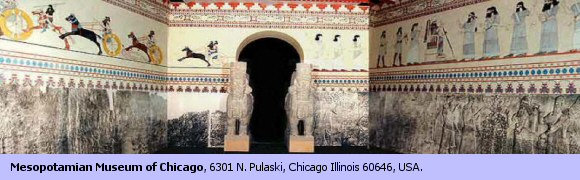
Mesopotamian Museum
- a collection of works spanning the ancient timeline of Assyria are located in this Chicago museum, includes a conference center with workshops, lectures, and distinguished speakers at various times throughout the year.
MMC | 6301 N. Pulaski | Chicago, Illinois 60646 USA
Posted: Sep-18-2010 | Visited: 313 | URL: https://www.atour.com/links/website
Religion
< Previous 1 2 3 4 5 6 7 8 9 10 11 12 13 14 15 16 17
18 19 20 21 22 Next >
|
|
|
|
|
 |
 |
 |
 |
 To know your past, is to know yourself.  From this decision, now admitted to be a blunder, date all the troubles in which we, Iraq and the League are involved today. It left the Assyrian country, except a very small area, within the Turkish frontier, and the Turks will not have the Assyrians back; it left over 30,000 Assyrians without homes in Iraq; and left Great Britain and Iraq with an insoluble problem. The story of the Assyrians from now on makes depressing reading, culminating in the present situation. Attempts were made to domicile them in the northern part of Iraq, and a certain number of Assyrians were settled; but, generally speaking, the problem was far from solved when, in 1932, the decision to give up the mandate was taken. Assyrians all along insisted that they would not be safe after the British left, scattered as they were in small parties among the Kurds. When the relinquishment of the mandate became a certainty, they took a desperate step to bring their case to notice.
-- British Brigadier-General J. G. Browne
The Assyrians: A Debt of Honour, 1937
|
|
 |
 |
 |
 |
|
|





 To know your past, is to know yourself.
