|

Indigenous People in Distress
Posted: Tuesday, June 17, 2003 at 11:05 AM UT | Printed: April 04, 2003 | Updated: June 26, 2022
 |
|
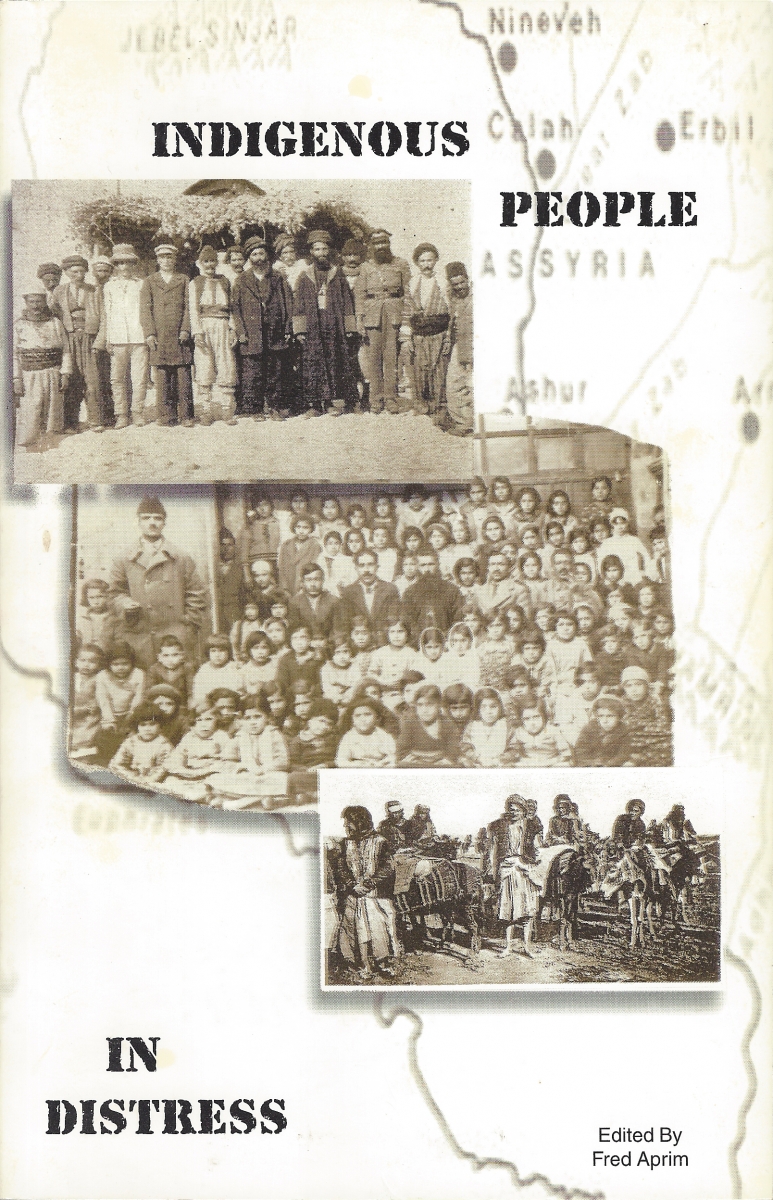
Indigenous People in Distress
|
Contents
PREFACE
Throughout the media coverage of Operation Iraqi Freedom, the emphasis continues to be predominantly on the oppression of the Iraqi Ba'ath regime against the Shi'aa Arabs and Kurds. The world, despite to a very limited cases, have continued to neglect the suffering of the Assyrians, the indigenous people of Iraq.
When the thought for an urgent need for the publication of a booklet about the suffering of the Assyrians came about, I was given the opportunity and responsibility of gathering information and putting it together. In doing so, I used material from many trustworthy Assyrian web sites such as www.aina.org (AINA), www.atour.com (Atour), and www.zindamagazine.com (Zinda). Other resources were information I have gathered throughout the years and are part of my upcoming book.
I hope that this humble work will give the reader a general idea about the Assyrians. The emphasis is on the Assyrians in the 20th century and the acts of oppression, persecution, abuse, terrorism, massacres, and genocides they have faced in the Middle East in general and Iraq in particular in that period.
 Fred Aprim — Editor, April 4, 2003.
profile | writings | website
INTRODUCTION
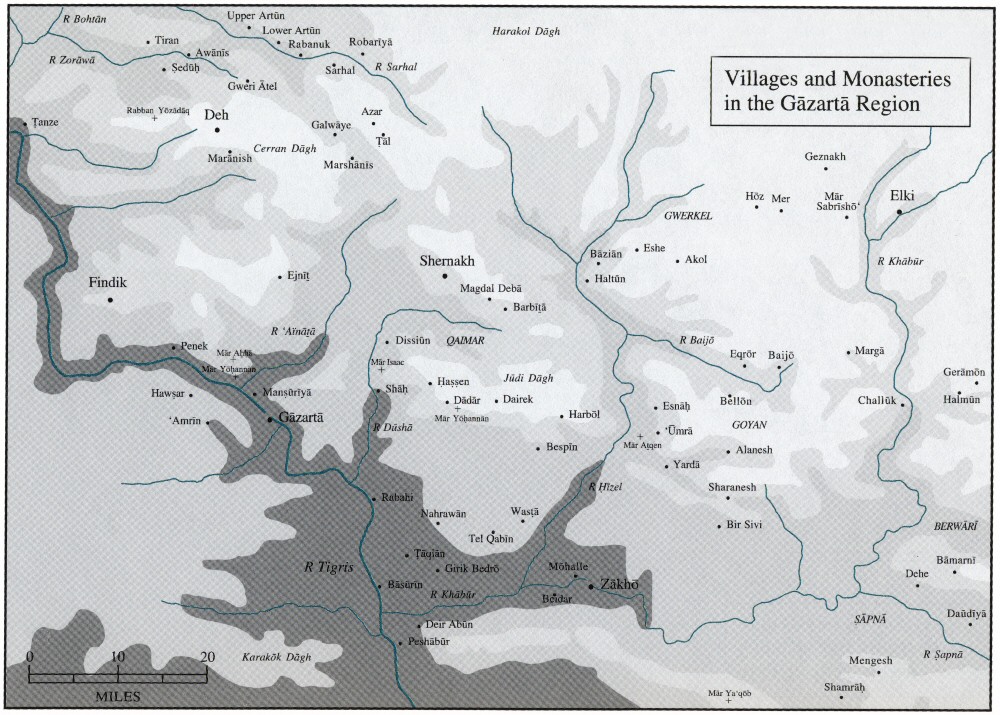
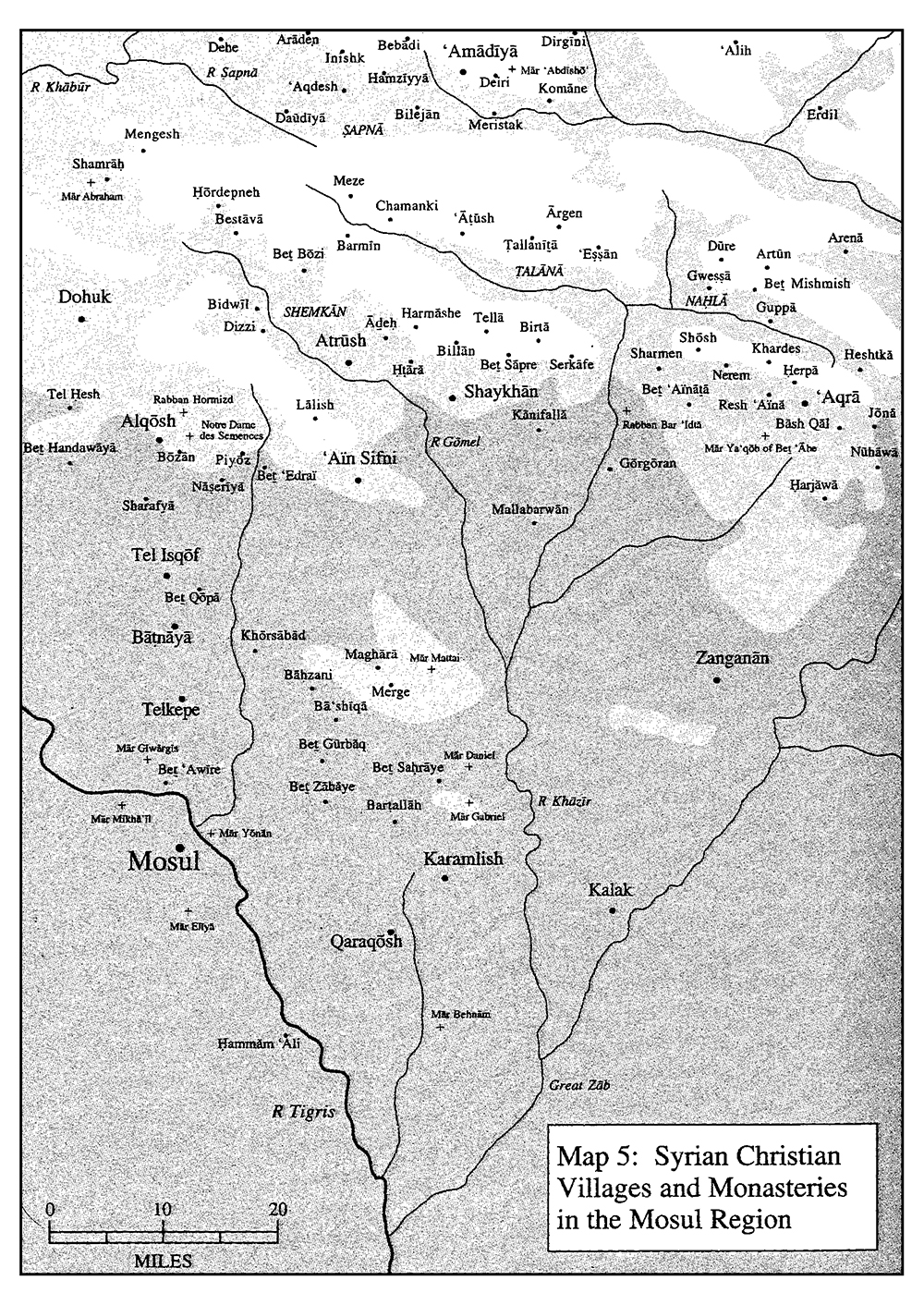
 Iraq, known throughout ancient history by the Greek term Mesopotamia (Land between Rivers, i.e. Tigris and Euphrates), is the home of many ethnic and religious groups such as Arabs, Assyrians, Kurds, Turkomen, Yezidis, Mandeans, Armenians, and others. The Assyrians of Iraq are the indigenous people of the land. They are the direct descendants of the ancient Assyrians and the heirs of the Assyrian Empire, whose heartland is in a geographical territory of what is today north of Iraq.
The Assyrians are one of the first people to accept the teaching of Jesus Christ in the First Century A.D. The Assyrian Christians make around five percent of the Iraqi population. They are also known by the following religious denominations: Nestorians, Chaldeans, Jacobites, or Suryan. The Assyrians use a dialect of the Aramaic, the language of Christ, known in the linguistic world as the Syriac language.

The English term Assyrians comes from the Greek "Assurios" through Latin "Assyrius." In their own language, i.e. Syriac (Neo Aramaic), the Assyrians are known as "Suraye" derived from "Asuraye" and yet earlier "Aturaye," originated from the ancient Assyrian Akkadian language "Ashuraye" or "Assuraye."
The Assyrians have experienced many massacres from the fall of their empire in 612 B.C., especially after adopting Christianity, but miraculously managed to survive. Assyrian Church and other historical records show that Persian Sassanids, Mongols, and Tartar massacred very large numbers of Assyrians. More recently, the Kurdish tribes under Badr Khan Beg massacred hundreds of thousands of Assyrians and destroyed many Assyrian villages in the middle of the 19th century (1842-1847) in southern Turkey and northern Iraq region. The massacres continued around the end of the 19th century by Kurdish tribes in the same region. During and in the immediate years after World War I, the Turkish, Kurdish, and Persian forces in Iran and Turkey committed acts of genocide against over 750,000 Assyrian Christians.

“Our Smallest Ally is now homeless, and dependent on our charity at Baqubah, for its lands and villages have been utterly destroyed, and it has the further mortification of seeing - from reasons beyond our control - that although it threw in its lot with the ultimately victorious side, Kurds, and others of the defeated enemy, are in practical possession of its ruined homesteads.”
— H. H. Austin
Brigadier-General
“Can Great Britian, now that she is responsible for order in the country, afford to neglect so valuable a military asset as this nation has proved itself to be?”
 — Dr. W. A. Wigram
 Our Smallest Ally (PDF, 17 MB)
 Our Smallest Ally: A Brief Account of the Assyrian Nation during the Great War
At the conclusion of World War I (1914-1918), the Paris Peace Conference of 1919 convened to settle the partition of the Ottoman Turkish Empire that fought beside Germany against the Allies. The entire Middle East, northern Africa and parts of Eastern Europe were one political region under the Turks for almost five centuries. With the conclusion of WWI and the Peace Conference, the political boundaries of the modern countries of Turkey, Iraq, Syria, and others were drawn. Iraq, Jordan, and Palestine were put under the British mandate while Syria (including Lebanon) under the French. In 1921, the present-day Iraq became officially a republic under the British mandate according to the League of Nations (became the United Nations after World War II).
After years of struggle of Iraqi nationalists against the British presence and mandate, Great Britain finally promised to assist in the admittance of Iraq in the League of Nations, as an independent and sovereign state. The Assyrians, who aided the British, French, and Russians during World War I, began to bring to the attention of the League that if the issues of the Assyrian national rights and settlement were not addressed and resolved before admitting Iraq into the League, the Assyrians were going to face a great danger under Iraqi Arab rule. Britain and the allies betrayed the Assyrians and broke all the promises they had made to the Assyrians before World War I. Finally, in 1932; Britain admitted Iraq into the League but with reservations by the Special Commission of the League of Nations concerning the Assyrians and the other minorities.
The Iraqi government promised the League to respect the rights of the non-Arab and non-Moslem inhabitants of Iraq. The Declaration of the kingdom of Iraq, issued in Baghdad on May 30, 1932, on the termination of the British mandatory power and admittance of Iraq into the League, contains clear concessions given by the Iraqi government to the Council of the League of Nations. Such concessions are expressed, only for example, in Chapter One, Article 2:1, which guarantees a “Full and complete protection of life and liberty will be assured to all inhabitants of Iraq without distinction of birth, nationality, language, race or religion.” Meanwhile, Article 4:3 states that “Differences of race, language or religion shall not prejudice any Iraqi national in matters relating to the enjoyment of civil or political rights, as, for instance, admission to public employment, functions and honors, or the exercise of professions or industries.”
The above and many other concessions were not exercised nor were they implemented. In fact, only few months after the admittance of Iraq in the League of Nations and gaining complete independence the Iraqi army moved to north of Iraq and massacred in cold blood over three thousand unarmed Assyrians. That massacre will be addressed later.
“Will America unjustly enrich herself, as the British, at the expense of this "Forgotten Ally" by allowing them to find their abject and ignoble defeat in their glorious victory of 1941?
The Middle East was the home of civilization. It is now the nerve centre of our problem...
There is but one solution to this explosive political situation - the realization of the natural aspirations of all the native elements.”
— Dr. David Barsum Perley
June 6, 1947
Assyrians in the Middle East
Are the Assyrians indigenous people or are they ethnic, religious and linguistic minorities? To answer this question properly one has to distinguish between the various regions the Assyrians are living today, meaning, one has to address every country case separately. Dr. Lincoln Malik, an Assyrian nationalist, states: "Assyrians are the indigenous people of Iraq and not a national or ethnic, religious and linguistic minority. This is a very important distinction with major political and juridical consequences related to Assyrians’ human rights in their ancestral homeland of Mesopotamia (today basically Iraq and regions of southern Turkey and northeastern Syria). The distinction between a national or ethnic minority and indigenous peoples is the historical and cultural ties of the people to the land."
Malik adds: "A national and/or ethnic minority is commonly people that have migrated to the land from the outside. Assyrians on the other hand do not have an ancestral homeland outside Iraq. As such, Assyrians are the indigenous people of the country, irrespective of their numbers compared to the Arabs and Kurds. Many in Iraq, driven by chauvinist or other political motivations, have sought to label Assyrians as an ethnic minority, or as the regime has attempted, a linguistic minority. These are nothing short of attempts to abridge Assyrians’ legitimate human rights in their ancestral homeland." (Atour)
Therefore, the Assyrians of Iraq are the indigenous people of the country; they are not just minorities. Meanwhile, the Assyrians of Lebanon, for example, are ethnic, religious and linguistic minorities because they are not the original people of Lebanon.
Throughout the history of modern Iraq and other newly established Middle Eastern countries, harassment, oppression, persecution, and massacres against Assyrians have continued in various shapes. Below, we will list only a sample of these acts by countries such as Iraq, Turkey, and Syria.
 |
|
Related Information |
 London Times News Articles
SECTION ONE: IRAQ
THE SIMMEL MASSACRE
August 1933
(Atour) Many of the Assyrians surviving the Holocaust of 1914-1918 had been gathered in refugee camps in Iraq pending final resettlement in an autonomous Assyrian homeland. In 1933, however, only few months after the declaration of the Iraqi Kingdom as an independent and admitting it in the League of Nations, the Iraqi government declared an ultimatum giving the Assyrians one of two choices: either to be resettled in small populations dispersed amongst larger Muslim populations that had recently been violently antagonistic or to leave Iraq entirely. Some Assyrians chose to leave to neighboring Syria and so notified the Iraqi government of their intention. In response, the Iraqi government first dispatched the Assyrian patriarch Mar Eshai Shimun to Baghdad for talks, but he was detained and put under house arrest. Later, the Iraqi government dispatched its army to attack the Assyrians fleeing into Syria. In the Iraqi army failed campaign against the armed Assyrians who crossed into Syria and some losses in their troops, the retreating Iraqi army massacred over 3,000 unarmed Assyrian civilians, mostly elderly, women and children in Simele and other surrounding towns in August of 1933. But before killing the women, they were forcefully undressed; pushed in the village street and paraded in front of the entire Iraqi army; violated; and then slaughtered. Upon his return to Baghdad, the commanding officer ordering the massacre, Bakir Sidqi, was hailed as a conquering hero and was promoted. Thus, the first official military campaign of the Iraqi army served as the newly independent government’s final solution to the Assyrian question.
The Ikha’ Party came to power in Iraq on March 20, 1933, under the Prime Minister Rashid ‘Ali al-Gaylani, Yasin al-Hashimi as the Finance Minister, Hikmat Sulayman as the Interior Minister and Nuri al-Said as the Foreign Minister. The Ikha’ and the Watani had condemned the Anglo-Iraqi treaty of 1930 and labeled it inconsistent with the sovereignty of Iraq on November 23, 1930, and promised the people to defeat it. But King Faysal was able to convince the Ikha’ and the new cabinet to accept the treaty for the time being since it brought independence to Iraq for a start. The Watani Party accused the Ikha’ leaders of compromising their party principles and began to put pressure on the government and issued a declaration on June 9, 1933, denouncing the Ikha’ government. The propaganda succeeded in undermining the confidence of the people in their government. In addition, the propaganda brought back the Shi’aa majority ruled by the Sunni minority issue. The government began to feel the pressure, started to lose its prestige, and needed a way out. The government exploited the Assyrian affairs as they demanded the implementation of the League of Nations decisions for a homogenous enclave or be left to seek a home somewhere else. The government used this to its own advantage and through it’s viscous handling of the Assyrians, it succeeded to re-direct the focus of the Iraqi people away from what was at hand and gain popularity once again. [Read Majid Khadduri. “Independent Iraq: A Study in Iraqi Politics since 1932”. Oxford University Press, London. 1951. pp. 39-40]
RELEASE OF ASSYRIAN (IRAQ) LEVY
1955
In 1955 the Assyrian (Iraq) Levy was dismantled and the Assyrian Levies were released unconditionally. They lost years of service to this Iraqi-British organization. Very few Assyrians who were pro-Iraqi government were given the opportunity to transfer and be part of the Iraqi army. The Assyrian Levi was instrumental in keeping the Iraqi integrity in tact throughout the years when it suppressed rebellions against the government. It also prevented Turkish incursion into Iraq in the early 1920s. Most importantly, the force was instrumental in 1941 to protect Iraq from the coup of Rashid 'Ali al-Gaylani who had made pact with Nazi Germany and was planning to allow the German army to enter Iraq.
MARGINALIZING THE ASSYRIAN ETHNICITY
1972
Decree # 251 of April 16, 1972 intentionally marginalized and undermined the ethnic and indigenous Assyrians. In that decree, the Baghdad Ba’ath regime granted the so called cultural rights to the citizens who “utter the Syriac language” from al-Athouriyoon wa al-Kaldan wa al-Suryan. The Arabic version of the decree stated: “Manih al-hiqooq al-thaqafiya lil-mowatineen al-natiqeen be al-ligha al-suryaniya min al-athouriyeen wa al-kildan wa al-suryan”. In other words, the Iraqi government presented the indigenous Assyrians as three religious denominations, Nestorians, Chaldeans, and Suryan (including the Jacobites).
The Iraqi government continues to refer to ethnic Assyrians as Christian Arabs while the Kurds in the north try to Kurdify northern Iraq by referring to Assyrians as Christian Kurds.
IMPRISONMENT OF ASSYRIAN SINGERS
October 19, 1978 to November 10, 1978
The Iraqi government imprisoned many Assyrian artists, especially singers and songwriters. These artists were accused of inciting Assyrian national feelings by performing Assyrian national songs in Assyrian festivals, parties and special celebrations. These artists were beaten and terrorized. They spent three weeks in jail without trial. In the first appropriate chance, the Assyrian artists one after another have fled Iraq to escape the continuous harassment of the Iraqi secret police.
The imprisoned artists were:
- David Easha
- Sammy Yaqu
- Albert Baba (Oscar)
ARABIZATION OF THE ASSYRIANS
The Assyrians had established many private schools in Baghdad, Mosul, and Kirkuk in the early parts of the 20th century. In the latter parts of 1970s, the Iraqi government began to close these schools and prohibited the teaching the Syriac language. The Assyrian secondary school that was opened in Kirkuk, for example, in accordance to the so-called 1972 minorities cultural rights decree lost its Assyrian name from its title and was open to the public. Assyrian civic and athletic clubs were nationalized, given Arabic names, and membership was opened to the public in an attempt to control them.
ARABIZATION AND ISLAMIZATION OF ASSYRIANS PURSUED
In 1977 and 1987 Iraqi general census, ethnic Assyrians were prohibited from registering as so. They were given the option of registering as Arabs or Kurds only. Furthermore, in 1979, the Iraqi government tried to make it mandatory that Assyrian Christians study the Koran, the holy book of Moslems. The Iraqi government handed the Koran to the Assyrian students in Iraqi public schools and asked them to read it. Major unrest within the Assyrian community erupted throughout Iraq and the plan was withdrawn later.
DEPORTATIONS OF ASSYRIAN FAMILIES
1980
Early in the Iraq-Iran War, which started in September 1980, the Iraqi authorities dragged many Assyrian families from their homes, loaded them in large lories, and deported them to Iran. These families did not have a chance for any type of a hearing. The deportation of many of these Assyrians who were born in Iraq was under the pretext that their parents or grandparents had moved to Iraq from Iran during World War I (1914-1918). It worth mentioning that even in 1918 the country of Iraq was not yet established and by the time when Iraq was created in 1921 these families were already inside Iraq and part of the population.
IMPRISONMENT AND EXECUTION OF ASSYRIAN NATIONALS 1984-1985
In the latter parts of 1984, dozens of Assyrian nationalists, members of the Assyrian Democratic Movement (ADM), were imprisoned by the Iraqi authorities; they were terrorized, beaten, and tortured. On February 3, 1985, three Assyrians of that group: Yousif Toma, Youbert Benyamin, and Youkhana Esha were executed.
THE FATE OF THE ASSYRIANS IN THE ANFAL CAMPAIGN September 24, 1988
Whilst the Kurds appear to have been the primary target of the Anfal, other minority groups suffered also. Assyrians, also referred to by the Kurds as Kurdish Christians, were also subjected to torture and executions during the campaign, and many of their churches were destroyed by Iraqi government forces. The Chaldeans are a Catholic subgroup of the Assyrians, who are ethnically distinct from the surrounding Kurds. Assyrians have been allied to Kurds since 1960s. There are approximately one million Assyrians in Northern Iraq, and they form one of the oldest Christian communities in the Middle East. Most of them now live in Mosuk, Dohuk and Arbil, as well as in Shaqlawa. The rural Assyrian communities have mainly disappeared. Many Assyrian villages were burned and bulldozed.
MORE ON THE ANFAL
Barely two weeks after the arrival of the first deportees at Baharka, the official loudspeakers announced that some of the camp’s inmates should present themselves at the police station without delay. Those singled out were either Assyrian and Chaldeans (a Catholic subgroup of the Assyrians) or members of the Yezidi sect. What happened to these two groups remains one for the great unexplained mysteries of Anfal: a brutal sideshow, as it were, to the Kurdish genocide. A few days later, a single khaki-colored military bus arrived, accompanied by an army officer and nine or ten soldiers, to pick up twenty-six people from the Assyrian Christian village of Gund-Kosa. ... None of those who was bussed from the camps ever reached their homes, and none was ever seen in the camps, such as Mansuriya (Masirik) and Khaneq, that were set aside for relocated Christians and Yezidis. The inescapable conclusion is that they were all murdered. An Assyrian priest interviewed by HRW/Middle East said that he had assembled a list of 250 Christians who disappeared during Anfal and its immediate aftermath. (Iraq’s Crime of Genocide, 1995, Human rights watch, pp. 209).
The Iraqi government has continued to target minority groups within Iraq. The Assyrian population is mainly concentrated in the northern governorates and has suffered as a result of being accused of collaboration with Kurdish groups. In addition to the executions during the Anfal, many Assyrians, together with Turkomans, have been expelled from Kirkuk as part of the Arabization of the area, renamed Al-Ta’mim or ‘Nationalisation’, in addition to Khanaqin, Sinjar, Makhmour, Tuz, Khoramatu and other districts. An estimated 94,000 people have been deported to the Kurdish-controlled area since 1991. (US Department of State Country Report on Iraq 2000, section 2.c.) For more info, please read also "Genocide in Iraq," A Middle East Watch Report, 1993, pp. 312-317
| Related Information |
|
“...Kurds, and Arabs, undermine the Assyrian identity, by referring to them, respectively, as Christian Kurds, and Arab Christians, to deny their Assyrian identity, because it indicates that they are the indigenous inhabitant of Iraq. ...there were no Kurds and Arabs settlements in the Plain of Nineveh before 1912 AD.”
|

 Who are Christians of Iraq and Syria?
KURDIFICATION OF ASSYRIAN VILLAGES IN NORTH OF IRAQ 1992
In 1992 some intellectual Assyrians published a communiqué, in it they warned against the continuous process of the Kurdification of the Iraqi people in north of Iraq. Then the ethnic and linguistic map of northern Iraq was not as it is today; some ten years after the no-fly zone has been established. For its importance, here is a passage from that communiqué:
“The Kurdish leadership, and in a well-planned program, had begun to settle Kurds and in large numbers around Assyrian regions like Sarsank, Barwari Bala and others. This Kurdish housing project was naturally to change the demographic, economic, and civic structure of the Christian regions in only few short years; a process that forced the Christian to emigrate as the vacant homes were overtaken by the Kurds.”
AMNESTY INTERNATIONAL (AI) COUNTRY REPORT, IRAQ 1995
• Francis Yusuf Shabo: born 1951 in Mangesh (Duhok Province), married with four children. An Assyrian Christian of the Chaldean sect, he was an active member of the ADM. He became a member of parliament after the May 1992 elections and was a member of the National Assembly’s Economic Committee. He was also responsible for dealing with complaints submitted by Assyrian Christians regarding disputed villages in Bahdinan from which they had been forcibly evicted by the Iraqi Government and subsequently resettled by Kurds. He was shot dead by armed assailants on 31 May 1993 as he approached his home in Duhok. No suspects were subsequently apprehended.
• Lazar Mikho Hanna (known as Abu Nasir): an Assyrian Christian born 1933 in Mangesh, married. He was a member of the ICP’s Central Committee for the Iraqi Kurdistan Region and was also a member of a three-person committee responsible for the IKF’s financial affairs. He was shot dead by armed assailants on 14 June 1993 near his home in Duhok. No suspects were subsequently apprehended.
No effective or meaningful investigations into these and other killings have been carried out to date. All the above victims were killed after the Kurdish administration was established. In most of these cases, the Council of Ministers set up committees, headed by investigating or court judges, to gather and examine the evidence. None have so far resulted in any convictions.
Amnesty International has received numerous allegations attributing these killings to special forces within the KDP, PUK and IMIK. The security apparatus of the KDP, Re[^]kkhistini Taybeti, and that of the PUK, Dezgay Zanyari, are said to have units akin to assassination squads, whose members receive orders from senior party officials. There is also widespread conviction that such unlawful and deliberate killings could not have been perpetrated without the knowledge, consent or acquiescence of the leaders of these two parties, to whom the security and intelligence apparatuses are ultimately responsible.
INJUSTICES COMMITTED AGAINST ASSYRIANS IN NORTHERN IRAQ
February 1, 1996
(AINA) Assyrians await the outcome of Dohuk’s rulers with regards to prosecuting the criminals who committed the murder of Edward Khoshaba. They believe the murder was committed under the direct guidance and planning of Deputy-Governor Farazanda Zubair, whose father was an Iraqi government puppet who committed crimes against the Catholic Sisters of the village of Aradin. Today, Farazanda has brought under his jurisdiction the Assyrian village of Hazarjat. The Assyrians believe that the current regime’s inactive stance regarding these crimes clearly demonstrates the mistreatment of the Assyrians.
On the morning of January 13, 1996, Wasan Mishael, a 16 year-old Assyrian girl from Simele was kidnapped at gunpoint from her home. Under extreme emotional and physical pressure and abuse, she was forced to denounce her Christian religion and marry one of her kidnapers. The courage of the young girl and the Assyrian population’s outrage forced Assyrian political parties to take action and force the capture of the criminals involved. As of this writing, however, the criminals have not been brought to justice under the present law. Those in charge in the area have not shown any justifiable reason for the delay in applying the law in this case; perhaps hoping that it will escape the memory of the Assyrian people.
On January 20, 1996, another minor was kidnapped. This time the victim was 13 year-old Assyrian girl named Janet Oshana, who resided in the village of Mulla-Urab, near the town of Zakho. The perpetrator of this crime is a Kurdish man named Khorshid Othman Kalash. Although the Assyrian community’s anger forced the kidnaper’s apprehension by the authorities, the young girl has not yet been returned to the custody of her parents, and neither has the offender Kalash been brought to face justice.
Finally, in the middle of January of 1996, the shrine of Mar Sbar Odisho (Saint Odisho) in the courtyard of Mar Gewargis (Church of Saint George) came under attack by vandals who desecrated the holy site. The authorities in the area disregarded this incident, neglecting to pursue any leads. As similar crimes against Assyrians and their institutions were revealed, the responsible authorities in the Dohuk area stalled and procrastinated, failing to respond in their duties to serve and protect the Assyrian people. In the Dohuk area, Nachir Barazani, one of the ruling party’s leaders, has confiscated a great number of fertile lands belonging to Assyrians, intimidating and terrorizing the land-owners to dissuade them from seeking compensation in return for their properties.
ADDITIONAL KURDISH ATTACKS ON ASSYRIANS IN NORTHERN IRAQ
June 24, 1996
(AINA) The following are additional cases of recent Kurdish attacks, persecutions, kidnappings, land expropriations, and murders that have recently been brought to my attention.
Mr. Edward Khoshaba of Aqla was tending his sheep last year when he came across 3 Kurds who had killed and butchered some of his livestock. When confronted, the Kurds attempted to kill Mr. Khoshaba. Mr. Khoshaba was able to kill off 2 of the attackers before the third fled to his home village. Reportedly, when the Kurd returned to his home village, a celebration had ensued as the Kurdish villagers had assumed that the Kurdish intruders had successfully killed Mr. Khoshaba in addition to his livestock. When they learned that 2 of the Kurdish intruders had died instead, the entire village mobilized to exact revenge.
Mr. Khoshaba likewise fled to an area controlled by his Assyrian compatriots. A standoff ensued for some time until Mr. Khoshaba’s parents (fearing a wholesale escalation in violence) convinced Mr. Khoshaba to turn himself in to the local authorities for an investigation and trial. Needless to say, the Kurdish authorities released Mr. Khoshaba to the relatives of the Kurdish intruders. He was tied up in their village and eventually butchered into hundreds of pieces on March 6, 1995. Prior to his death, he was reportedly struck in the head repeatedly by an axe by one of the elder women of the village. NONE of his murderers have been brought to justice. There has been no investigation of these crimes. There has been no investigation of the authorities that evaded their responsibilities.
The Kurdish leader who reportedly heads this village is Qaem Qam Farzanda Zbeer. Mr. Zbeer has now extended his threats, persecutions, and vast land expropriations to the Assyrian village of Hzarjat. In another incident, on January 13, 1996 armed Kurds kidnaped Wassan Mishael, a sixteen-year-old girl from Simele. She was threatened and forced to renounce her Christian faith. Then she was forced to marry one of the Kurdish kidnappers. The attackers have been found and identified. The information has been brought to the attention of the local governmental officials. There has been no investigation. None of the attackers have been brought to justice, there has been no trial.
On January 20, 1996 an armed man named Khorsheed Uthman Galash kidnaped Janet Oshanna, a 13-year-old girl from Mal-Urab near Zakho. The kidnapper has subsequently been identified and all information has been provided to the authorities. No investigation has been carried out. The attacker has not been brought to justice. The young girl has not yet been returned to her family Sometime in mid-January, the holy room of Saint Sbar Eshoo located in St Gewargis Church in Zakho was burglarized There has been no investigation of this crime as well.
Almost universally, crimes against Assyrians by Kurds are tolerated and even condoned in the Dohuk area of Northern Iraq. The local authorities have made it clear that a Kurdish attack against an Assyrian will go unpunished. One of the leaders, Nasherwas Barazani, has actually used his position in government to prevent them from demanding proper compensation. He uses the ongoing attacks against Assyrians to encourage further destabilization and further land grabs.
There is a general belief that the authorities are engaged in efforts to effect a demographic change in the area. They aim to drive out the Assyrians.
PKK ABDUCTS ASSYRIAN GIRL
September 28, 1996
(AINA) Witnesses in North Iraq said that a group of armed PKK guerillas abducted a fifteen-year-old Assyrian girl named Ahlam Patrus Nissan from her village on September 16, 1996. Local farmers and others who witnessed the kidnapping said they saw the girl being carried off with an expression of fear on her face. The PKK admitted that they have the girl but they claim she joined them willfully. They have refused to allow anyone to speak to the teenaged girl. Apparently, it is common practice among some Kurdish tribes that after such abduction, the young girl is forced to marry her kidnapper. It is also common that in such cases, the victim is forced to renounce her Christian faith and convert to Islam.
AMNESTY INTERNATIONAL (AI) COUNTRY REPORT, IRAQ 1997
In May, two unarmed members of the Assyrian Democratic Movement (ADM), Samir Moshi Murad and Peris Mirza Salyu, were killed in ‘Ain Kawa, near Arbil, by Kurdish students allegedly associated with the PUK. The ADM members were reportedly intervening to settle a dispute between Kurdish and Assyrian students when they were deliberately shot. Although PUK leaders condemned the killings, no one was brought to justice.
WHEREABOUTS OF ASSYRIAN EMPLOYEES IN SADDAM’S SERVICE REMAIN UNKNOWN
Amnesty International
Posted March 1997
(ZINDA) In March 1997, Amnesty International wrote to the Iraqi government seeking clarification of the fate and whereabouts of six Assyrians arrested in October 1996 and the details of any legal proceedings made against them. All six Assyrians lived in Baghdad and were employed in the Presidential Palace of Saddam Hussain. They were arrested on suspicion of involvement in an attempt to poison President Hussain. No response has yet been received. The arrested are: Gewargis Hormiz Oraha, Yousip Adam, Khamo Amira, Kora Odisho, Shimon Khoshaba al-Hozi, Petros Elia Toma and William Matti Barkho.
For more information, contact...
International Secretariat
1 Easton Street
London Wc1x 8DJ
United Kingdom
KURDISH MOB VICIOUSLY MURDERS TWO ASSYRIANS
February 12, 1997
(AINA) On February 10, 1997 two Assyrians, Mr. Lazar Mati and his son Havel Lazar, were dragged out of their prison by a vigilante group of 200 armed Kurds and were brutally killed. Prior to their murder, they were taunted, tortured, and finally butchered. Before the murder, 100 Kurds stormed the family home of Mr. Mati and burned it to the ground Mr. Mati and his son had been imprisoned in the governmental jail in Shaqlawa. Their was no resistance by the governing authorities. There has been no investigation into the killings. There is, once again, collusion between murderous Kurds and those entrusted (in the “Safe Haven”) with the public safety.
Apparently, Mr. Mati’s daughter had been forcibly kidnapped four years ago by a Kurd named Mohamed Babakir. It appears to be customary in many similar instances of kidnapping and rape by Kurds, that she had been forced to marry her kidnapper. She was a minor, younger than eighteen years old. I presume she had been forced to renounce her Christianity as well. There was no help forthcoming from the government. However, it is generally agreed that the families had met years ago and resolved the matter. There was reportedly no remaining animosity between them.
One day prior to the murders of the two Assyrians, the Kurd who had kidnapped Mr. Mati’s daughter was found mysteriously killed. That night at evening prayers, the local Kurdish mullah declared that only Mr. Mati could have wanted the Kurd killed. The mullah then proceeded to demand that the Kurds savagely kill Mr Mati and destroy his home. He reportedly declared that a Christian cannot kill a Muslim. Needless to say, there was no proof, no investigation. The savage mob was incited and the local security forces acquiesced.
The local Kurdish officials had arrested Mr. Mati and his son under suspicion for the killing of the Kurd found mysteriously dead. It was in the local jail that the Kurds found the two Assyrians and killed them. The government in Shaqlawa which had been so quick to arrest the Assyrians in order to seek out justice for the killed Kurd, now have done absolutely nothing regarding the vigilante killing of the Assyrians held in their custody.
Mr. Lazar Mati, the father was born in 1943 and his son, Mr. Havel Lazar was born in 1972. To his credit, Barzani came to Shaqlawa and reportedly condemned the killings. In addition, in his statement, he acknowledged recent acts of violence, burglaries, and arson by Kurds against Assyrian homes and shops in the Shaqlawa area. He noted a pattern of intimidation on the part of Kurds in the area. Neither he nor the local government have taken any concrete steps to investigate and seek justice in this case of extrajudicial killings. Reportedly, the Kurds have never punished one of their own when the victims have been Assyrian. It is generally believed that the recent rhetoric is simply that.
BACKGROUND ON MURDERED FATHER AND SON
March 1, 1997
(AINA) Regarding the most recent killing of the two Assyrians in Shaqlawa, the Kurd who had been found killed has been identified. His name was Mohamed Babakir, he had kidnapped the daughter of Lazar Matti, the Assyrian who, along was with his son Havel Lazar, was butchered by the Kurdish mob.
However, it is generally agreed that the families had met years ago and resolved the matter. There was reportedly no remaining animosity between them. The local government has not begun any investigation into the initial killing or the subsequent massacre.
Additionally, the father was born in 1943 and the son in 1972. To his credit, Barzani came to Shaqlawa and reportedly condemned the killings. In addition, in his statement, he acknowledged recent acts of violence, burglaries, and arson by Kurds against Assyrian homes and shops in the Shaqlawa area. He noted a pattern of intimidation on the part of Kurds in the area. As usual, though, neither he nor the local government have taken any concrete steps to investigate and seek justice in this case of extra judicial killings. The Kurds have never punished one of their own when the victims have been Assyrian. It is generally believed that the recent rhetoric is simply that. As you well know, only international pressure from organizations like yours can help to reduce these acts of persistent, recurrent, and premeditated terror.
ATTACKS AGAINST ASSYRIAN RESTAURANT OWNERS IN NORTHERN IRAQ March 9, 1997
(AINA) Over the past 12-18 months, three separate attacks have been launched against Assyrians in the area of Khalidia. The attacks have led to two deaths and one critical wounding. All of the attacks have been against owners/operators of clubs or restaurants (nadi) that serve alcohol. Allegedly, the Kurdish Islamic Fundamentalists have objected to the serving of alcohol in these areas. It is believed by many Assyrians that these attacks are in fact at least encouraged, if not provoked, by the government.
An elderly Assyrian woman whose husband was one of the murdered Assyrians has relayed this information to us. It has been very difficult to get even this small bit of information from her (over several interviews) because she is in tremendous fear of reprisals against her remaining relatives there. She has insisted that her name or her husband’s name not be used. This appears to be a recurring theme in the Assyrian community, and it makes news gathering more difficult. The widespread use of this terror makes it more difficult to expose it.
ASSYRIAN EXECUTED IN BAGHDAD, IRAQ
July 4, 1997
(AINA) On May 23, 1997, Kamal Kiriakos Ablahad, an Assyrian, was shot and killed in Baghdad, Iraq. Mr. Ablahad was employed at the residence of Jamal Al-Tikriti, the son-in-law of Saddam Hussein.
Following the shooting, Mr. Ablahad was immediately rushed to the hospital where he was declared dead. Mr. Ablahad’s kidneys were removed for organ transplantation. The medical examiner’s report declared the death a suicide. Examination of the body revealed a single gunshot to the head as the cause of death. In addition, Mr. Ablahad’s right index and middle fingers were shot off as a consequence of the shooting. Due to the gunshot involving Mr. Ablahad’s right fingers and head, members of the community in Baghdad have reported that the shooting was not in fact a suicide. It has been suggested that Mr. Ablahad was killed in execution fashion and that prior to being shot, he had raised his right hand in an attempt to shield his head and face from the gunshot. The bullet then passed through his fingers and head.
Since access to medical care has greatly deteriorated following the embargo against Iraq, it has been reported that the motivation for the killing may have been for the purpose of securing Mr. Ablahad’s kidneys for transplantation.
ATTACKS UPON ASSYRIANS IN CENTRAL IRAQ
August 16, 1997
(AINA) According to sources from Baghdad, Iraq, a recent series of violent murders of Assyrian Christians in the Baghdad area has left many Assyrian Christians deeply concerned for their safety and well being. On July 25, 1997 the Arabic language newspaper Al-Hayat reported that the Iraqi National Congress announced that Uday, the son of Iraqi leader Saddam Hussein, had shot and killed an Assyrian girl earlier in June. The Assyrian girl, Asil Salman Mansour, was last seen walking home within the predominantly Christian Doura district of Baghdad. Witnesses reported that the girl was stopped by a “presidential” vehicle and was forced into the vehicle by Uday’s bodyguards. Ms. Mansour was taken to the Presidential Complex at Al Jadiriya. According to the news report, Uday tried to have sex with the girl but failed. In a subsequent fit of rage, he shot and killed the girl. Reportedly, Uday has become embittered, depressed, and easily angered since the failed assassination attempt on his life and his subsequent paralysis.
Following the girl’s murder, Uday ordered the payment of $700, an Oldsmobile automobile, and a fifty-dollar monthly stipend to the family as compensation for the loss of their daughter. The grief-stricken Assyrian family has been ordered not to report the incident; they have accepted the gesture out of fear of further reprisals by the government.
On the morning of July 27, 1997, three armed men entered the home of Polus Younan, a sixty-two-year-old Assyrian member of the Chaldean Catholic Church. Mr. Younan was originally born in Habbania. His home is located in the N’eriya w’Gayra’ section of Baghdad and was occupied by Mr. Younan, his wife Medina Shinoel, and their 16 year old son, Maffai. Ms. Medina Shinoel survived the attack and reported her account to the police. She witnessed the repeated stabbing of her husband in the back with a large knife until the blade of the knife protruded through Mr. Younan’s chest. Upon dying, Mr. Younan was rolled into sheets by one assailant as the other two attackers turned their attention to Ms. Shinoel. The attackers began striking Ms. Shinoel with the butt end of their rifles until most of her teeth were broken. Throughout the attack, the assailants demanded information regarding the family’s money and savings. The attackers then started slashing Ms. Shinoel’s 16-year-old son, Mattai in order to obtain more information. Since the boy is deaf and mute, he was unable to satisfy the attackers’ questioning. They proceeded to slash the boy until he began to slowly lose consciousness, at which point they moved him to the bathroom and placed him in a bathtub.
In yet another murder, another Assyrian, 35-year-old Yousif John Yacoub, was brutally stabbed to death on April 12, 1997 while in his home in Baghdad, Iraq. Three Arab men, employed as school guards in a nearby school, were allegedly instructed by a cleaning woman at the same school to attack and rob Mr. Yacoub. According to Mr. Yacoub’s neighbors who witnessed the attack, Mr. Yacoub was stabbed in the back, neck and abdomen. The neighbors notified the police, who arrived prior to Mr. Yacoub‘s death. Mr. Yacoub survived long enough to identify his attackers and to give the name of a nearby relative to be notified. The police kept Mr. Yacoub in his home for questioning while he was bleeding uncontrollably until his death. They never sought to transport him to a hospital in time to save his life. In addition, Mr. Yacoub ‘s relative was never contacted. The relative heard about the incident one day later, at which point Mr. Yacoub had already died. Mr. Yacoub’s relative finally arrived at the home only to find that the police had ransacked the place and removed any valuables or evidence. Two weeks later, Mr. Ameed Shurta, a high ranking police officer and member of the ruling Ba’ath party, along with his wife and children, occupied Mr. Yacoub’s house. The police have refused to return any of Mr. Yacoub’s possessions to the family. Mr. Yacoub’s sister, a Sumerian and Akkadian scholar residing in London, England, has requested that at the very least, the family’s photo albums which have great sentimental value ought to be returned. The police have refused. Mr. Yacoub’s family has reported that governmental and police personnel are accomplices in this crime. The police have released the cleaning woman and have claimed that one of the attackers has escaped. The other two were reportedly held for questioning but no recent information is available regarding their whereabouts. It is suspected that because of their ties to government accomplices, they will not be punished.
RECENT ATTACKS ON ASSYRIANS IN NORTHERN IRAQ
August 19, 1997
(AINA) The Kurdistan Democratic Party (KDP) has announced that at 8:10 a.m. on February 23, 1997, Mr. Francis Harriri survived an assassination attempt. Mr. Francis Harriri is an Assyrian from northern Iraq and is the governor of the province of Arbil. The attack reportedly took place during Mr. Harriri’s trip to the provincial headquarters in Arbil. Although Mr. Harriri survived the attack, two of his bodyguards as well as five civilian bystanders were reportedly wounded.
According to the KDP, their initial investigation points to involvement by the Patriotic Union of Kurdistan (PUK). Specifically, the KDP has accused Mr. Kosrat Rasool, allegedly a PUK political officer, of masterminding the attack. The KDP has further suggested that the motivation behind Mr. Rasool’s assassination attempt may have been the intentional disruption of the recent Ankara conference and ongoing peace negotiations in northern Iraq between the two warring Kurdish groups.
In their February, 1995 report on human rights abuses in northern Iraq since 1991, Amnesty International (AI) has listed at least sixteen victims of political assassination in northern Iraq. One of the victims was Mr. Francis Yusuf Shabo. According to AI, Mr. Shabo was “born in Mangesh (Duhok Province), married with four children. An Assyrian Christian of the Chaldean sect, he was an active member of the Assyrian Democratic Movement. He became a member of parliament after the May 1992 elections and was a member of the National Assembly’s Economic Committee. He was also responsible for dealing with complaints submitted by Assyrian Christians regarding disputed villages in Bahdinan from which they had been forcibly evicted by the Iraqi Government and subsequently resettled by Kurds. He “was shot dead by armed assailants on 31 May 1993 as he approached his home in Dohuk, No suspects were subsequently apprehended.”
Another victim mentioned by AI was “Lazar Mikho Hanna (known as Abu Nasir): an Assyrian Christian born 1933 in Mangesh, married. He “was a member of the Iraqi Communist Party’s Central Committee for the Iraqi Kurdistan Region and was also a member of the three-person committee responsible for the Iraqi Kurdistan Front’s financial affairs. He was shot dead byarmed assailants on 14 June 1993 near his home in Dohuk. No suspects were subsequently apprehended.”
Regarding political assassinations, AI has noted that several Kurdish groups have established “assassination squads” in northern Iraq. “The security apparatus of the KDP, Rekkhistini Taybeti and that of the PUK, Dezgay Zanyari, are said to have units akin to assassination squads, whose members receive orders from senior party officials. There is also widespread conviction that such unlawful and deliberate killings could not have been perpetrated without the knowledge, consent or acquiescence of the leaders of these two parties, to whom the security and intelligence apparatuses are ultimately responsible.” AI also disclosed “details of extensive surveillance operations of named individuals, as well as references to killings and attempted killings by the Islamic Movement in Iraqi Kurdistan (IMIK).”
RECENT KURDISH ATTACKS AGAINST ASSYRIANS IN NORTHERN MESOPOTAMIA (IRAQ)
December 28, 1997
(AINA) Attacks against Assyrian civilians in northern Iraq and southern Turkey by various armed Kurdish groups have increased in recent weeks. According to a news release by the Assyrian Democratic Movement (ADM) in northern Iraq, fighters from the Kurdistan Worker’s Party (PKK) ambushed seven unarmed Assyrian civilians from Mangesh, Duhok on December 13, 1997. Two of the Assyrians were immediately killed in the initial volley of gunfire. Five others were seriously wounded. The PKK guerillas reportedly approached the remaining five wounded Assyrians and, seeing that they were still alive, subsequently shot four of them dead as they lay bleeding. Those killed were all residents of Mangesh and included Slewo Khoshaba, Samir Esho, Majid Shimon, Arkhan Hermiz, Salem Yousif and Najid Mikho. One woman, Wardia Yousif the wife of Najid Mikho, survived with a serious leg wound until December 26th when she too died.
This latest attack follows an earlier attack against an Assyrian man and his wife belonging to the Syrian Orthodox Church in Mzezakh, Turkey. On September 25, 1997, Kurdish fighters entered the home of Mr. Iskandar Araz and his wife and brutally killed them without cause.
A press release by the National Liberation Front of Kurdistan on December 21,1997 denied PKK culpability in the December 13 attack against the seven Assyrians. The press release stated that the attack was “staged by the Turkish army together with the KDP (Kurdistan Democratic Party) on the Assyrian village of Mankish in the Duhok region...” The press release further added that “the statements accusing the PKK of this dirty provocation were put out from Duhok which is under the control of the KDP.”
Over the past few years, Assyrian reports from northern Iraq and southern Turkey have detailed a pattern of escalating attacks designed to intimidate and terrorize the Assyrian civilian population of northern Mesopotamia by all of the armed Kurdish factions. The United Nations and international human rights organizations have documented that in southern Turkey alone, Assyrian villages are alternately attacked by PKK guerillas demanding aid in their war against Turkey and by pro-government Kurdish village guards as well as the Turkish military seeking retribution. According to the Assyrian Democratic Organization (ADO) over 30 Assyrians have been killed over the past few years. Different Kurdish groups have burned numerous villages. Scores of young girls have been abducted, raped, and forced to convert to Islam. As a result of the ongoing turmoil, less than 10,000 Assyrians remain in their ancestral homes out of a population of 130,000 just twenty years ago. Typically, Kurdish groups as well as the Turkish military involved in attacks against Assyrians accuse other Kurdish groups of responsibility.
In the United Nations Special Rapporteur Report on Religious Intolerance, Mr. Abelfattah Amor summarized the state of the Assyrians in Turkey: “In a communication dated 5 September 1994, the Special Rapporteur transmitted the following observations to the government of Turkey: They (Assyro-Chaldeans) are also reported to be victims of regular attacks by armed individuals and groups who not only rob them of their property and abduct their daughters, but also perpetrate murder, thereby creating an atmosphere of fear, apparently with the aim of forcing them to leave their villages. Thus, since 1975, more than 100,000 Assyro-Chaldeans have left the country and only 10,000 remain.”
In northern Iraq, both the Patriotic Union of Kurdistan (PUK) and the KDP have been responsible for murders of Assyrians as well as assassinations of Assyrian political leaders. According to Amnesty International’s February 1995 report on northern Iraq, “The security apparatuses of the KDP, Rekkhistine Taybeti, and that of the PUK, Dezgay Zanyari, are said to have units akin to assassination squads, whose members receive orders from senior party officials. There is also widespread conviction that such unlawful and deliberate killings could not have been perpetrated without the knowledge, consent, or acquiescence of the leaders of these two parties, to whom the security and intelligence apparatuses are ultimately responsible. The names of individuals alleged to be members of assassination squads within the KDP and PUK have been submitted to Amnesty International, including by officials of both parties who supplied information about the other’s security and intelligence activities.” Amnesty International also disclosed “details of extensive surveillance operations of named individuals, as well as references to killings and attempted killings by the Islamic Movement of Iraqi Kurdistan (IMIK).”
In addition, land expropriations continue with over 50 villages remaining illegally and forcibly occupied by Kurds belonging to various groups. Abduction of young girls with subsequent rape and forced conversion to Islam have also been perpetrated by all Kurdish groups.
In an interview with the Assyrian International News Agency, Assyrians who had recently visited northern Iraq, suggested that the general belief in the area is that the various Kurdish armed factions are pursuing a policy of intimidation of the civilian population, in order to complete the ethnic cleansing of the Assyrians from their ancestral homeland. A familiar pattern of deflecting accountability from one Kurdish group to another was noted by Assyrians whereby the PUK blames the KDP who blames the PKK who blames the Turks, etc. One Assyrian speaking on condition of anonymity, in order to not endanger relatives remaining in northern Iraq, responded to questions regarding the United Nations sponsored “Safe Haven” designed to protect Iraqi minorities from the excesses of the Iraqi central government by saying “Safe Haven? Safe for whom? Safe from whom? They are all trying to eliminate us!”
AMNESTY INTERNATIONAL
AI COUNTRY REPORT, IRAQ
1998
In February, two members of the Assyrian community, Lazar Mati and his son Havel Lazar, were deliberately killed when a group of armed men stormed the KDP-controlled Asayish Prison in Shaqlawa where the two men had been detained. No investigation was known to have been carried out into the killings nor into the apparent failure of the authorities to protect the prisoners.
KURDISH GUERILLAS KILL ASSYRIAN CIVILIANS August 2, 1998
(Atour) DOHUK, Iraq -- A few weeks ago, Mr. Tawer Goreal from the Ennony-Barwar Village at the Assyrian region in Northern Iraq, was killed by Kurdish guerillas as he, his wife and children were driving home from Ennony Village back to the city of Dohuk. The Kurdish guerillas stopped him at the city of Zakho as he was driving with his family. No explanation has been given by the Kurdish Authorities. SARSENK, Iraq -- A few days ago, 2 Assyrians were killed at the Baderush Village, situated south of Sarsenk and 20 Assyrians were arrested by Kurdish army troops. The reasons behind this force and intimidation was to drive out the Assyrians from this village in order to begin developing a Kurdish village in Baderush. No explanation has been given by the Kurdish Authorities.
ASSYRIAN MOTHER AND DAUGHTER MURDERED IN ARBIL December 10, 1998
(AINA) Bahra, a magazine of the Assyrian Democratic Movement centered in northern Iraq, reported that on Wednesday, December 9, 1998 the Assyrians of Ainkawa and Shaqlawa in northern Iraq mourned the passing of two Assyrians, victims of yet another brutal attack.
Mrs. Nasreen Hana Shaba born in 1963 and her young daughter Larsa born in 1995 were killed when a bomb exploded in their home. The bomb was planted by unknown assailants in the home of Mr. Najat Toma, located in the district of Terawa in Arbil. Mrs. Nasreen Hana Shaba and her daughter Larsa were killed when they opened the door to their home, which triggered the bomb.
No one has claimed responsibility for this act of terrorism against the Assyrian community of northern Iraq. The Bahra report also mentioned that this family has no affiliations with any political organizations and saw no motive for the murder of the innocent Assyrian mother and daughter.
The Christian Assyrian community of northern Iraq has suffered countless acts of terror and murder committed by certain Kurdish groups since the establishment of the so-called Safe Haven in northern Iraq. It is widely believed that such acts of terror are designed to intimidate and drive out the indigenous Assyrian community of northern Iraq from their ancestral homeland. The Assyrian community of northern Iraq fear that this latest attack will go unpunished since the Kurdish Authority has yet to punish any Kurd whose crime was against Assyrians.
TERROR CAMPAIGN AGAINST ASSYRIANS IN NORTHERN IRAQ
January 17, 1999
(AINA) Recent press releases emanating from northern Iraq by the Assyrian Democratic Movement (ADM) on January 7, 1999 and the Assyrian Patriotic Party (APP) on January 9, 1999 have documented an increasing spiral of violence directed at the Assyrian community in northern Iraq.
According to the press releases and independent visitors from northern Iraq, an explosive device was detonated on December 9, 1998 in front of the home of an Assyrian, Mr. Salman Toma, in the Terawa area of Arbil. The explosion resulted in the deaths of his wife Nasreen Shaba and their daughter Larsa Toma. A second explosion targeted an Assyrian convent in the Al Mal’ab district of Arbil in December 1998. The most recent explosion being on January 6 in the 7th of Nisan area of Arbil. This most recent bomb was planted at the front doorsteps of Fr. Zomaya Yousip. Fortunately, no casualties were reported but the home sustained extensive damage.
In another incident, a Kurdish assailant using a shotgun shot Mr. Rimon Emmanuel in the back as he returned home from work in Bebad, Iraq. Mr. Emmanuel sustained several buckshot to his back and head but survived with severe injuries. Local Kurdish authorities dismissed the case against the assailant after “influential” Kurds in the area intimidated Mr. Emmanuel into dropping charges. The attack against Mr. Emmanuel underscores the refusal of Kurdish authorities to prosecute any attacks against Assyrians. This most recent series of violent attacks against Assyrians using concealed explosive devices is an escalation in the terror scheme designed to intimidate and subsequently drive out the Assyrians of northern Iraq. In the past, assassinations of Assyrian leaders and civilians, kidnappings, land expropriations, Assyrian educational restrictions, and generalized harassment has been linked to the main Kurdish groups with military capabilities. The overt goal of intimidating the Assyrian community is believed to further ethnically cleanse northern Iraq of Assyrians and to force the remaining Assyrians to acquiesce to Kurdish political objectives.
Amnesty International’s February, 1995 report on northern Iraq concluded that “The security apparatus of the KDP, Rekkhistine Taybeti, and that of the PUK (Patriotic Union of Kurdistan), Dezgay Zanyari, are said to have units akin to assassination squads, whose members receive orders from senior party officials. There is also widespread conviction that such unlawful and deliberate killings could not have been perpetrated without the knowledge, consent or acquiescence of the leaders of these two parties, to whom the security and intelligence apparatuses are ultimately responsible. The names of individuals alleged to be members of assassination squads within the KDP and PUK have been submitted to Amnesty International, including by officials of both parties who supplied information about the other’s security and intelligence activities.” Amnesty International also disclosed “details of extensive surveillance operations of named individuals, as well as references to killings and attempted killings by the Islamic Movement of Kurdistan (IMIK).”
Assyrians visiting from Iraq have reported that bombings of such technical sophistication must be engineered by these same major Kurdish organizations or the Iraqi regime. Since the Kurdish groups are in control of the area, have remained silent, and have refused to mount any investigation into the attacks, it is generally believed that these Kurdish groups are responsible for the attacks.
LIFE FOR ASSYRIANS IN NORTHERN IRAQ ANYTHING BUT NORMAL
February 19, 1999
(AINA) The American brokered reconciliation between the Patriotic Union of Kurdistan (PUK) and the Kurdistan Democratic Party (KDP) announced in September 1998 was designed to revitalize the parliament established in northern Iraq following the Gulf War. The parliament of northern Iraq had been disbanded following internecine fighting by various Kurdish ethnic groups and political parties that led to thousands of people being killed.
The Final Statement on the reconciliation talks outlined a timetable for specific, concrete confidence-building measures designed to ensure a smooth transition to the subsequent reinstitution of the parliament on the basis of a “unified, pluralistic, and democratic Iraq.” According to the September 17, 1998 timetable, January 1, 1999 was to mark the “first meeting of the interim assembly.” The first responsibility of the interim joint government was to establish a plan to “normalize Arbil, Dohuk, and Suleimaniyah,” the three northern Iraqi provinces included in the declaration.
For the Assyrians of northern Iraq, December and January have been anything but normal. The last two months have been marked by escalating violence culminating in a series of shootings and bombings. On December 9, 1998 the Toma family house was bombed resulting in the deaths of Nasreen Shaba and her daughter Larsa Toma in Arbil. Another explosion rocked an Assyrian convent in December also in Arbil. A third bomb targeted Fr. Zomaya Yousip’s house in Arbil on January 6, 1999. Unfortunately, no investigation has been carried out by the Kurdish authorities to determine the source of or motives behind the bombings. In a recent statement regarding these tragedies Amnesty International reported, “We are currently in the process of raising a number of individual cases with the KDP authorities and…that we will be addressing the case of Nasreen Maria Shaba and her daughter as well as the case of other Assyrians”.
The timetable also envisions that the interim joint government establishes a plan for the organization of elections by April 1, 1999. During this period, the interim assembly is also asked “to conduct a census of the area in order to establish an electoral register” leading up to elections. The silence and blatant lack of concern by the PUK and KDP supposedly entrusted to “normalize” Arbil has left the Assyrian community in northern Iraq wondering how these very same Kurdish organizations are now entrusted with carrying out a fair and honest census of Assyrians.
Many Assyrians are convinced that the bombing campaign is intended to intimidate the Assyrian community still residing in the northern three provinces. The bombings appear to be part of a greater policy to further ethnically cleanse the northern Provinces. Killings of Assyrians by Kurdish assailants go uninvestigated and unpunished. Kurdish authorities and their associates expropriate historically Assyrian lands. Assyrian churches, convents, and clergy have been attacked. Efforts to Kurdify the Assyrians have led to restrictions on the teaching of the Assyrian language. Assyrians are not recognized as a distinct ethnicity, but only referred to as “Kurdish Christians”. Young Assyrian girls are kidnapped, raped, and forcibly converted to Islam. When viewed in the context of over 200 villages having been destroyed by the Iraqi government in the 1970’s and 80’s, this additional persecution by the Kurds has understandably led to the intended mass exodus of Assyrians from their homes in northern Iraq.
As has been reported previously, the Kurds intend to further diminish the numerical significance of the remaining Assyrians by separately classifying Assyrians and Chaldeans despite proclamations by the respective patriarchs and American national organizations that Chaldeans and Assyrians are indeed one people.
In a recent letter to Secretary of State Madeleine Albright, Congressman Rod Blagojevich and Ray LaHood expressed concern regarding the fate of Assyrians in Iraq by stating “our support for an alternative to Hussein’s dictatorship is hollow if we do not insist that the opposition also uphold democratic values and respect the rights of all people. We urge you to articulate, clearly and forcefully, to the Kurdish parties in Northern Iraq that continued U.S. support is dependent on their respect for the rights of all peoples in their area of influence.”
ASSYRIAN WOMAN MURDERED IN NORTHERN IRAQ
June 19, 1999
(AINA) Attacks against Assyrians in the northern Iraq’s “Safe Haven” have continued despite efforts in Washington to forge a democratic and pluralistic Iraqi opposition to the central government in Baghdad.
Earlier this month, the body of Ms. Helena Aloun Sawa, an Assyrian woman, was found by a shepherd partially buried in a shallow grave in Dohuk province near Dohuk dam.
Ms. Sawa was a twenty-one year old Assyrian from the village of Bash in the Nerwa o Rakan region of Dohuk province. Ms. Sawa was the daughter of Mr. Aloun Sawa, an Assyrian member of the Kurdistan Democratic Party (KDP). Mr. Sawa had been killed in 1991 by Iraqi government forces while fighting for Mahsoud Barzani’s KDP during the uprising against the Baghdad regime following the Gulf War. Mr. Sawa was formally recognized by the KDP as a martyr and, as is customary for fallen fighters of the KDP, the party had promised a pension to the Sawa family in recognition of the sacrifice made by Mr. Sawa. After only two monthly stipends, however, the pension was inexplicably denied to the Sawa family while other Kurdish families continued to receive their pensions.
When the Sawa family appealed to the KDP for reinstatement of the pension, the KDP instead suggested that the Sawa’s turn over their young daughter Helena to work as a housekeeper for a senior KDP leader in order to continue the monthly payments. Thus, out of desperation the Sawa’s were obliged to ask their daughter to work for a pension that other Kurdish families were provided outright. Consequently, Ms. Sawa came to work in the home of Mr. Azet Al Din Al Barwari, a higher echelon KDP operative and a leading member of the political bureau of the KDP. Ms. Sawa lived and worked in the Al Barwari home and was allowed to return to her family’s home only once monthly.
Most recently, Ms. Sawa was expected home for her monthly furlough from work on May 5, 1999. When she did not arrive at her family home, the concerned Sawa family inquired regarding Helena’s whereabouts. The Sawa family had already been deeply troubled about Helena’s well being since she had appeared agitated and distraught on her previous visits home. Mr. Al Barwari and the KDP denied any knowledge about Ms. Sawa’s whereabouts since she was alleged by the Kurds to have left the Al Barwari home on May 3. The KDP offered no assistance in searching for Ms. Sawa. Mr. Al Barwari has used his authority within the KDP to intimidate the Sawa family into not pursuing an investigation of the crime. Once again, the KDP’s reluctance to launch an investigation and Mr. Al Barwari’s intimidation has led many Assyrians to suspect KDP and Al Barwari complicity in the murder of Ms. Sawa.
More than four weeks after her disappearance, Ms. Sawa’s shallow grave was discovered by a shepherd tending his flock. The decomposed body was partially exposed and appeared to have been partially eaten by scavenging wild animals. The Sawa family was brought to the burial site in order to provide a positive identification of the remains of the body. Following identification, the body was exhumed and taken to a Dohuk hospital for examination. Because of the mysterious circumstances of Ms. Sawa’s murder and the family’s belief that she may have been raped, an autopsy was requested. However, because of Kurdish intimidation, the final report has been delayed and is not expected to be scientifically objective or valid.
The Helena Sawa tragedy resembles a well-established pattern of Kurdish authority complicity in attacks against Assyrians in the northern Iraqi provinces. Most Assyrians in Iraq are skeptical that the Kurdish authorities will ever investigate, capture or let alone punish these Kurdish assailants on behalf of their Assyrian victims especially if the assailant is politically connected. However, it is hoped that with the West’s recent interest in safeguarding minority human rights, these ongoing attacks against the Assyrian Christians in Iraq will prompt investigations by international organizations and governments. Kurdish leaders such as Mr. Al Barwari who is believed to hold a Swedish passport may be vulnerable to investigation if he ever leaves northern Iraq or when law and order return to Iraq itself.
The tragedy of the Sawa family underscores the dire situation of Assyrians living in Iraq. Whether they reside under Kurdish occupation or within government controlled areas, Assyrians often find themselves the targets of persecution and attacks. Although Mr. Sawa felt obligated to sacrifice his life fighting against Iraqi government oppression on behalf of the KDP, his daughter fared no better living within the United Nations administered “Safe Haven” in a territory controlled by the same KDP. Nor have dozens of other Assyrians such as Francis Shabo- an Assyrian member of the parliament of northern Iraq who Amnesty International said was killed by KDP operatives- fared any better. The murder of Helena Sawa and the scores of other attacks against Assyrians including rapes, abductions of young girls, murders, attacks on Churches and clergy, cultural and linguistic persecution, and land expropriations by Kurds in the past several years have had the cumulative effect of terrorizing the indigenous Assyrian community in northern Iraq.
The premeditated and well established pattern of directing attacks against Assyrians and then steadfastly denying justice to the victims by Kurdish leaders has led to the gradual exodus of Assyrians from their ancestral homes. Such acts reinforce the conviction amongst many Assyrians that the “Safe Haven” designed to protect people from the ravages of the central government has in fact provided the Kurds license to victimize the Assyrians in northern Iraq. Such acts also have the effect of galvanizing the Assyrian community in the Diaspora to seek international recognition of a safe haven for Assyrians as a necessity for Assyrian survival in Iraq. A territorially delineated Assyrian safe haven within predominantly Assyrian areas would allow the recognition and protection of Assyrians, their lands, schools, and churches. Perhaps within an Assyrian safe haven, an Assyrian family like the Sawa’s could feel secure enough to continue to live in a land inhabited by their ancestors for several millennia.
U.S. DEPARTMENT OF STATE
Annual Report on International Religious Freedom for 1999: Iraq Released by the Bureau for Democracy, Human Rights, and Labor Washington, DC, September 9, 1999
"The Government does not recognize political organizations that have been formed by Shi'a Muslims or Assyrian Christians… "The Special Rapporteur and others reported that the Government has engaged in various abuses against the country's 350,000 Assyrian and Chaldean Christians, especially in terms of forced movements from northern areas and repression of political rights.
Assyrians and Chaldeans are considered by many to be a distinct ethnic group as well as the descendants of some of the earliest Christian communities, but the Constitution does not provide for an Assyrian or Chaldean identity. These communities speak a distinct language (Syriac), preserve two important traditions of Christianity in the east, and have a rich cultural and historical heritage that they trace back over 2,000 years. Although these groups do not define themselves as Arabs, the Government, without any historical basis, defines Assyrians and Chaldeans as such, evidently to encourage them to identify with the Sunni-Arab dominated regime.
Assyrian religious organizations have complained that the Government applies apostasy laws in a discriminatory fashion, since Islam is the official religion of the state. Assyrians are permitted to convert to Islam, whereas Muslims are forbidden from converting to Christianity.
Most Assyrians live in the northern governorates, and the Government often has suspected them of "collaborating" with Iraqi Kurds. In the north, Kurdish groups often refer to Assyrians as Kurdish Christians. Military forces destroyed numerous Assyrian churches during the 1988 Anfal Campaign and reportedly tortured and executed many Assyrians. Both major Kurdish political parties have indicated that the Government occasionally targets Assyrians as well as ethnic Kurds and Turkomen in expulsions from Kirkuk, where it is seeking to Arabize the city. The Government does not permit education in languages other than Arabic and Kurdish. Public instruction in Syriac, which was announced under a 1972 decree, has never been implemented. Thus, in areas under government control, Assyrian and Chaldean children are not permitted to attend classes in Syriac."
KDP BLOCKADES, ATTACKS ASSYRIAN VILLAGE
October 16, 1999
(AINA) On August 25, 1999, armed Bahdinanis of the Kurdistan Democratic Party (KDP) imposed a blockade against a string of eight Assyrian villages in the Nahla area of northern Iraq. Earlier in August, the Bahdinanis of the KDP had ordered the villagers not to transport any food into the villages under threat of force. Having no other viable recourse, they appealed to United Nations (UN) and the International Committee of the Red Cross (ICRC) monitors in northern Iraq to intervene on the Assyrians’ behalf. Fortunately the UN and the ICRC demanded a lifting of the blockade against the Assyrian villages as at least a portion of provisions directly originated from the UN “oil for food” Resolution 986 program. In order not to appear to be in defiance of a UN resolution, the Bahdinanis temporarily relented. However, intimidation and on again off again blockades have continued despite UN protests.
The Nahla area lies several kilometers east of Aqra in the Dohuk province of northern Iraq. The eight wholly Assyrian villages remaining in the Nahla district include Merokeh, Belmat, Khalilaneh, Hizaneh, Jouleh, Chameh Chale, Rabatkeh, and Kash Kawa. The Assyrian villages in this district have remained relatively isolated and it has been this relative isolation that has thus far spared them. However, on account of their isolation, Assyrian villagers there are dependent upon provisions brought in from the Aqra city center. With no developed road system, supplies are carried by hand or mule monthly across dirt roads and through mountain passages. Even prior to the August blockade, the villagers were sometimes exposed to confiscation of their goods by Bahdinani bandits or KDP operatives often after the villagers had trekked several kilometers on foot and just as they had nearly reached their homes.
Following the initially successful UN and ICRC intervention, armed KDP Bahdinani thugs continued their campaign of terror against the Assyrian villages. On the night of August 27 and 28, the Bahdinanis besieged the village of Kash Kawa and indiscriminately fired automatic weapon rounds upon Assyrian homes. Fortunately, no Assyrians were harmed by the shots although livestock were killed and property was damaged. The armed KDP operatives subsequently entered the village intimidating the inhabitants. Residents of the village were pulled from their homes in the middle of the night and gathered into a group. Mindful of previous Kurdish atrocities, women and children cried in horror and fear. Two Assyrian men, Mr. Samir Daniel and Mr. Yonadam Moshe were singled out from the crowd and severely beaten upon their heads with the buts of rifles, leading to concussions and severe external hemorrhaging – all before terrified women and children.
The alleged “justification” by the Bahdinani leadership for the initial blockade and subsequent brutality against the residents of Kash Kawa was a supposed belief by the KDP that Kurdistan Workers Party (PKK) guerillas were benefiting from the relief supplies entering the village. With the arrest of the PKK leader, Mr. Abdullah Ocalan, in Turkey, significant numbers of fully armed PKK fighters have fled Turkey into northern Iraq. The presence of still more armed Kurmanji tribesmen from Turkey into the area has been unsettling and destabilizing. Assyrian villages have also been raided for supplies and food by PKK guerillas in recent months. The increasing tension between the PKK and the KDP has raised the specter of still greater blood feuds by the various Kurdish ethnic groups and political parties, leaving the Assyrians in a precarious position.
The Assyrian villages in the Nahla region are a small remnant of what was a markedly more robust and significant Assyrian presence in the Aqra area a mere twenty to thirty years ago. Many of the surrounding Assyrian villages were destroyed by the Iraqi government in the 1960’s and 1970’s and subsequently illegally expropriated by Bahdinani settlers. Ironically, the pretext for the Iraqi government destruction of Assyrian villages in northern Iraq was that they were aiding these same Bahdinanis of the KDP that are now attacking the Assyrians under the pretext that the Assyrians are now aiding the Kurmanjis of the PKK.
The Assyrians in northern Iraq have not supported either of the two warring ethnic factions, as the Assyrians are only too painfully cognizant of the previous destruction and expropriation of Assyrian villages by the PKK in southeastern Turkey and by the KDP in northern Iraq. Assyrians in the area also remember all too well the December 1997 massacre of seven unarmed Assyrian civilians from Mangeshe, Dohuk in northern Iraq by the PKK (12-28-1997 AINA report). In the case of Kash Kawa the Bahdinani forces of the KDP eventually left the village after wreaking havoc, confiscating supplies, and ultimately, finding no evidence of pro-PKK sentiment.
KDP INTIMIDATION, EXPROPRIATION OF ASSYRIAN VILLAGES CONTINUES
Posted 11-30-1999
(AINA) Bahdinani security forces of the Kurdistan Democratic Party (KDP) stepped up their campaign of intimidation against the eight remaining Assyrian villages in the Nahla area near Aqra in northern Iraq. The earlier reported August midnight attack on the village of Kesh Kawa was followed by a similar raid on the Nahla village of Belmat on September 10, 1999. As in the previous attacks, approximately one dozen armed security forces of the KDP surrounded the village and fired automatic weapons into the air rousing alarmed and terrified villagers from their sleep.
Assyrians in the Nahla region with grievances have had little if any legal recourse from Kurdish authorities in the past several years. The village of Belmat has been especially sensitized to the difficulties in relying on the Bahdinani concept of justice. In 1995, Mr. Edward Khoshaba, a resident of Belmat, was tending his sheep on his own land when he apparently surprised three Bahdinani bandits who had killed and butchered some of his sheep. Seeing Mr. Khoshaba outnumbered, the bandits attacked Mr. Khoshaba when they were confronted. Mr. Khoshaba was able to kill two of his assailants in self-defense as the third fled to his neighboring village. In order to avoid greater tension between Assyrians and Bahdinanis, Mr. Khoshaba surrendered to the supposed legal authorities in order to have a proper investigation of the attack.
The local Bahdinani police immediately surrendered Mr. Khoshaba to an angry mob of the attacking bandits’ family and fellow villagers. Mr. Khoshaba was taken to the Bahdinani village where he was brutally beaten. Then after being tied to a tree he was taunted and tortured for hours before he was finally killed. The whole drawn out, sordid, death ordeal was treated by the Bahdinani villagers as a sort of celebratory festival until the climactic “honor” of finally killing Mr. Khoshaba was given to the eldest woman of the village who repeatedly hacked Mr. Khoshaba on his head with an axe until he lost consciousness and died. Mr. Khoshaba’s hacked, bloody, and broken corpse was later ignominiously dumped near his home. Neither the murderous mob nor the legal authorities that denied Mr. Khoshaba due process were ever captured, investigated or punished for his extra judicial lynching.
The underlying motivation for continued attacks and intimidation against Assyrian villages such as in the Nahla region and other parts of northern Iraq is best illustrated by recent declarations by the KDP regarding the Assyrian village of Millet Arwana adjacent to the Nahla region Assyrian villages. Following intimidation and harassment, many of the Assyrian inhabitants of this village had left northern Iraq. Recently, it has been reported that Mr. Hisbyer Al Zebari of the KDP has ordered that ownership of the village lands be redistributed with over 80% being handed over to Bahdinani settlers belonging to the Zebari Kurdish tribe. Mr. Al Zebari is reportedly a political bureau member of the KDP as well as an in law relative of KDP leader Masoud Barzani.
Various ethnic groups and armed political groups in northern Iraq such as the predominantly Bahdinani KDP, the predominantly Sorani Patriotic Union of Kurdistan (PUK), and the predominantly Kurmanji Kurdistan Workers Party (PKK) have used the pretext of instability and violence to further consolidate their land holdings by force at the expense of unarmed Assyrian villagers. With a premeditated policy of intimidation, threats, and harassment, Assyrians are forced from their ancient ancestral lands as various illegal settlers, often related to the political leadership ordering the violence, occupy more and more Assyrian villages. The Iraqi government has demonstrated complicity in this program in so far as over 200 Assyrian villages were destroyed in the 1960’s and 70’s and were subsequently resettled by Bahdinanis and Soranis. With a renewed influx of the predominantly Kurmanji PKK, additional tension and conflict can be expected in the future. Since the Gulf War, more than fifty additional villages have been expropriated by various Sorani and Bahdinani groups, the most recent being Millet Arwana. The attacks against the remaining villages in the Nahla region are merely the latest salvos in a continuing policy of ethnically cleansing the region of Assyrians.
These attacks against Assyrians continue unabated within the United Nations sanctioned “Safe Haven” at a time when opposition groups including the KDP and PUK are meeting in Washington and elsewhere in an attempt to forge a “democratic and pluralistic” society in Iraq. Throughout these deliberations, Assyrians have been at best under represented and sometimes completely unrepresented. Those Assyrians most intimately aware of the policies directed against Assyrians by the Iraqi government and the Iraqi opposition are sidelined as certain self-described victims of the Baghdad government within the opposition continue to pursue the same policy of terror, assassination, forced migration, and subsequent resettlement against the remaining Assyrian villages throughout northern Iraq. With the periodic terror forays into the Nahla villages and the continued land expropriations, certain groups within the Iraqi opposition hope to eventually erase yet another chapter of Assyrian history from northern Iraq - the heartland of Assyria.
CHRISTMAS BOMBINGS OF ASSYRIANS RESUME IN NORTHERN IRAQ 12-25-1999
(AINA) This year’s holy Christmas season has been marred by escalating violence against Assyrian Christians. According to news reports from the Ankawa Homepage released on December 19, 1999 and the Assyrian Democratic Movement (ADM) released on December 16, 1999, another Assyrian was assassinated in Arbil on December 15, 1999. Described as a well-liked and humble man, Mr. Habib Yousif Dekhoka was a sixty-year-old Assyrian man of the Chaldean Church and a lifelong resident of Ankawa. According to the two independent press releases, Mr. Dekhoka was a merchant in the Sheikh Allah business district in the Arbil city center. Apparently, Mr. Dekhoka was an Assyrian businessman in an area of the Sheikh Allah retail district dominated by Behdanani and Sorani storeowners.
Mr. Dekhoka had been threatened several months ago by armed thugs attempting to force him to give up his business. On one occasion, Mr. Dekhoka’s store had been firebombed. He survived that attack and succeeded in rebuilding his business all the while withstanding escalating harassment and intimidation. On December 15, 1999, however, a bomb planted in his store exploded and took his life. Following the blast, Mr. Dekhoka endured several hours of excruciating pain until his burned and bloodied body finally succumbed.
The ADM press release also noted that another bomb had been recently placed in the car of another Assyrian produce merchant in the Sheikh Allah business center of Arbil. Although the car was destroyed, the victim of the attack survived despite sustaining serious injuries.
The Ankawa Homepage press release attributed the attack against Mr. Dekhoka to “Islamic Kurdish Fundamentalists” without specifying which specific ethnic group while the ADM press release apparently mindful of possible violent reprisals stated that it was not clear who were the perpetrators of the attacks. Mr. Dekhoka was known to be extraordinarily vigilant and probably anticipating another attack. The fact that his assailants were able to inconspicuously plant a bomb powerful enough to destroy the store and kill Mr. Dekhoka despite his heightened vigilance suggests a technical sophistication beyond the capability of rogue bandits or business competitors. It is widely believed that politically organized and motivated terrorists with an agenda to further intimidate and eradicate Assyrians from the area are responsible for this as well as numerous other attacks.
This year’s Christmas bombings follow the same pattern as last year’s attacks against Assyrians (AINA 12/10/98 and 1/17/99). During Advent of last year, Mr. Najat Toma’s home was bombed leading to the deaths of Mr. Toma’s wife Ms. Nasreen Hana Shaba and his three-year-old daughter Larsa. An Assyrian convent in the Al Mal’ab district of Arbil was also bombed in December 1998. Still more, Fr. Zomaya Yousip’s house was bombed on January 6, 1999 but fortunately Fr. Yousip survived.
Both last year’s and this year’s attacks are believed to target Assyrian Christian institutions and individuals during the holy Christmas season of Advent in an effort to demoralize and terrorize the remaining Assyrian population of Arbil. As is customary in such attacks against Assyrians, there is no effort on behalf of the Behdanani authorities to condemn, investigate or prosecute the attackers. Involvement by the authorities is suspected because once again there is no genuine effort to improve security for Assyrians. The sophistication required to carry out such a series of attacks necessitates an organized effort with technical, logistic, and financial resources- resources readily available only to the authorities in northern Iraq.
Assyrians in Arbil are once again being targeted because Arbil is one of the three provinces in northern Iraq that the KDP and PUK hope to ethnically purge of Assyrians. However, Arbil lies within the historic heartland of Assyria, within the Assyrian Triangle. The attachment of Assyrians to their ancestral homeland remains unshakable and Assyrians are determined to continue their uninterrupted four thousand-year history in Arbil. Despite enduring countless massacres throughout their more than four thousand year history in Arbil, the Assyrian community continues to have a robust presence with a vibrant culture.
In their 1995 report on “Human Rights Abuses in Iraqi Kurdistan since 1991,” Amnesty International (AI Index 14/01/95) stated that “Amnesty International has received numerous allegations attributing these killings to special forces within the KDP, PUK (Patriotic Union of Kurdistan), and IMIK (Islamic Movement in Iraqi Kurdistan). The security apparatus of the KDP, Rekkhistini Taybeti, and that of the PUK, Dezgay Zanyari, are said to have units akin to assassination squads, whose members receive orders from senior party officials. There is also widespread conviction that such unlawful and deliberate killings could not have been perpetrated without the knowledge, consent or acquiescence of the leaders of these two parties, to whom the security and intelligence apparatuses are ultimately responsible (page 94).”
Quite regrettably, rather than openly investigating the scores of attacks against Assyrians, the armed tribal militias of the predominantly Behdanani KDP and the predominantly Sorani PUK have instead intensified their efforts to intimidate vulnerable villagers and to threaten Assyrian political leaders into denying that the repeated attacks, murders, land expropriations, rapes, abductions, and bombings against Assyrians actually occur. This egregious policy of intimidation and political blackmail against vulnerable Assyrians literally held hostage in their homes represents a dangerous escalation in the Behdanani and Sorani scheme to silence Assyrian protests against their continued victimization.
IRAQ INTENSIFIES PERSECUTION OF ASSYRIANS Posted 10-4-2000
(AINA) Attacks by the central government in Iraq against the Assyrian language and culture have continued unabated despite calls by the international community for the Baghdad regime to respect the rights of all of its citizens. According to an Assyrian National Congress (ANC) press release dated September 10, 2000, the Iraqi Directorate General of Intelligence in early August summoned several Assyrians, including intellectuals, clerics, and activists, for interrogation in Mosul (ancient Nineveh) and Baghdad. Security agents reportedly interrogated the Assyrians regarding Bet Nahrain Magazine, a California based Assyrian cultural journal. According to the ANC, “Bet Nahrain magazine is the literary organ of Bet Nahrain Organization, an educational and cultural association affiliated with the Assyrian National Congress.”
Apparently, the Iraqi security agents were most interested in determining whether the readers of the magazine were members of the Bet Nahrain Democratic Party (BNDP), an Assyrian political organization that formally calls for Assyrian autonomy in Iraq and is also affiliated with the ANC. After being detained for several hours, the Assyrians were eventually released with demands that they sever all ties to the magazine.
This most recent intimidation of Assyrians by the central government demonstrates the extent of the regime’s crack down against any expression of Assyrian culture. These scare and intimidation tactics are not taken lightly by Assyrians within Iraq and abroad, as the brutality of the regime in general and the previous execution of Assyrian activists in particular have been widely documented by international organizations.
This heightened sensitivity to Assyrian cultural expression follows earlier threats made by the Iraqi Ministry of Education against the Assyrian language schools established in northern Iraq following the Gulf War. In a November 25, 1999 warning published in the Kurdistan Observer, the Iraqi Minister of Education described Assyrian schools in the north as “phony” and “part of a scheme by enemies of the Iraqi people to break up the country.” The Minister’s statement also threatened to punish those Assyrians who establish and even attend the schools. These Assyrian schools were described as a “betrayal” of the country and an intrusion into its unity and sovereignty. Although the Behdanani and Sorani leaders in the north are supposedly opposed to the Baghdad government, all parties agreed earlier to prohibit Assyrian secondary schools to open in northern Iraq until an international outcry spearheaded by U.S. Congressmen forced an adjustment of policy in northern Iraq (AINA, 10-20-1998 and 11-05-1998). Today, the single Assyrian secondary school in northern Iraq is privately funded by Assyrians.
Growing pressure from the international community has mounted on Iraq to recognize Assyrian grievances and legitimate calls for recognition. Although Iraq has found it relatively easy to at least theoretically recognize their restive Behdanani and Sorani “Kurds,” Baghdad has now hunkered down and increased the persecution of the indigenous Assyrians. Rather than recognize Assyrians as an indigenous ethnic minority, Baghdad, like the Behdananis and Soranis in the north, recognize Assyrians solely as a Christian minority with no implicit national rights. All the while, any expression of Assyrian language or culture is labeled a threat to national sovereignty and strictly forbidden.
Furthermore, reports from Iraq suggest that Baghdad’s response to calls for greater Assyrian political rights from international Assyrian organizations is to create an alternative Assyrian leadership in Baghdad independent of Diaspora based groups. It is Baghdad’s hope that such a vulnerable leadership literally held hostage in Baghdad would more easily serve to whitewash previous and ongoing abuses against Assyrians. Quite understandably, such a leadership would hardly be able to request recognition of Assyrian rights and the full expression of Assyrian culture let alone demand any degree of autonomy for Assyrians. Seen in this context, the Bet Nahrain magazine incident was seen as a threat by Baghdad for two reasons: first, because it symbolized a persistent and growing Assyrian awareness despite decades of persecution and second, it exposed Baghdad’s fears of Iraqi Assyrian ties to legitimate anti-Baghdad Diaspora based Assyrian political organizations seeking real Assyrian rights and democratic change in Iraq.
U.N. BLASTS IRAQ FOR 'WIDESPREAD TORTURE'
December 4, 2000
(Reuters) "The U.N. General Assembly condemned the government of Iraqi President Saddam Hussein on Monday for using "widespread terror" and systematic torture to repress dissent and urged it to abide by international human rights treaties…
"The General Assembly appealed to the Iraqi government to abide by international human rights treaties and force the military and security forces to respect international law. It also called for sweeping judicial reforms that would make the judiciary independent and punish any extrajudicial killings. Political opposition should not be subjected to intimidation and repression, it said. Iraq should respect the human rights of all ethnic and religious groups, the resolution continued. It urged the government "to cease immediately its repressive practices aimed at the Iraqi Kurds, Assyrians and Turkmen" who have been subject to deportations."
TERRORIZING ASSYRIANS
February 12, 2001
(Zinda) A bomb explodes at the house of Rafael Dawud Hilo in the Shorish District in the city of Arbil. Mr. Hilo's wife is a teacher at the Assyrian school in Arbil.
ASSYRIAN GOVERNOR OF ARBIL ASSASSINATED
Posted 02-19-2001
(AINA) On the morning of February 18, 2001, Assyrians were enraged to learn that the Assyrian governor of the northern Iraqi province of Arbil, Mr. Franso Hariri was assassinated in Arbil. Mr. Hariri was the highest ranking Assyrian member of the predominantly Behdanani Kurdistan Democratic Party (KDP). His appointment as Governor of the ancient Assyrian city within the heartland of historic Assyria at one time proved a powerful political symbol to Assyrians of their historic link to the land. Mr. Hariri was reportedly also a central committee member of the KDP. In many ways, Mr. Hariri was believed to be an important check on an otherwise blatantly accelerating Sorani- Behdanani drive to cleanse northern Iraq of the indigenous Assyrian population. In the end, this very perception of Hariri’s role in the preservation of Assyrian lands and demography may have resulted in his brutal assassination.
Mr. Hariri had previously been the target of other assassination attempts (AINA August 19, 1997). Although details surrounding his death are still sketchy, in the past Mr. Hariri had been targeted by Sorani “hit squads” belonging to warlord Jalal Talabani’s Patriotic Union of Kurdistan (PUK). Equally relevant, though, is that the appointment of an Assyrian to such a prominent position never quite sat well with many Behdanani tribal insiders of the KDP who regularly argued and worked for a “demographically pure” northern Iraq devoid of the indigenous Assyrian population. It is widely accepted that on account of his Assyrian roots, Mr. Hariri was always a doubly hated target of the PUK, the central Iraqi regime, as well as numerous KDP insiders.
The assassination of Mr. Hariri culminates three especially trying months for Assyrians in northern Iraq who continue to witness intensified intimidation and harassment. In the Nahla region of northern Iraq where Assyrian villages have remained under constant threat of expulsion by Behdanani KDP terrorist units (AINA October 16, 1999 and AINA November 30, 1999), another two Assyrian villages, Dawria and Girbesh, were formally divided primarily amongst Behdanani occupiers and a few Assyrian villagers remaining in their homes. Since December, 2000 Assyrian lands in Zakho and Dohuk have reportedly been illegally expropriated by Massoud Barzani’s nephew Najervan who now heads the parliament in northern Iraq. These Assyrian lands have reportedly been commercially developed into hotels and retail outlets by those with tribal connections to the Barzani clan without due process or compensation to their Assyrian owners. In Sarsing as well, Assyrian lands are being confiscated and subsequently appropriated to illegal occupiers often with ties to the tribal hierarchy. As with previous assassinations of Assyrian leadership, it is believed that such attacks are intended to quell Assyrian demands for justice while continuing the Behdanani-Sorani ethnic cleansing of Assyrians from their territories.
Assyrians once again find themselves demanding an open investigation into the slaying of yet another Assyrian leader while also impressing upon the international community that the UN sponsored “Safe Haven” has led to greater and greater victimization of Assyrians at the hands of Soranis and Behdananis. As of yet, no credible claim for the assassination of Mr. Hariri has been identified. However, with an unusual singularity of purpose, the otherwise ostensibly warring PUK, KDP, and Iraqi regime have often demonstrated a cynical concurrence in their approach to suppressing Assyrian political, civil and human rights objectives. It remains to be determined which warlord’s assassins were responsible for this most recent attack against the Assyrian Governor of Arbil, Mr. Franso Hariri.
MUNICIPAL ELECTIONS IN NORTHERN IRAQ MARRED BY THREATS OF VIOLENCE
Posted 7-2-2001
(AINA) The May 26 municipal elections in the so-called “Safe Haven” in northern Iraq were once again muddied by discrimination against basic Assyrian political, civil, and human rights. In a lead up to the elections, the predominant Assyrian political party in northern Iraq, the Assyrian Democratic Movement (ADM) sensed that the impending elections were jury-rigged and consequently prepared for a possible boycott of the election.
In the past few years, Behdanani and Sorani tribal chieftains have been at great pains to present themselves to the world as respecting political rights as well as diversity within their area of military occupation. In the recent past, international sympathy for the Behdanani-Sorani struggle for occupation of northern Iraq has greatly suffered on account of repeated accounts of Kurdistan Democratic Party (KDP) and Patriotic Union of Kurdistan (PUK) persecution of the indigenous Assyrians. Fearing still greater erosion of international support, the Behdanani and Sorani political organizations proposed a meeting with ADM leaders aimed at ensuring ADM participation in the election process. The hastily arranged meeting was held prior to the May 23 date that the ADM was scheduled to issue a formal election boycott declaration to Assyrians in northern Iraq.
In a surprise reversal, however, the May 23 ADM press release instead urged Assyrians to participate in the elections. Recognizing no real chance for fair elections or proportionate Assyrian success in the pre-rigged election process, the ADM claimed that later integrating elections would increase Assyrian representation in the future. The predetermined outcome of the election materialized as predicted by Assyrian political analysts with overwhelming victories for Behdanani tribal elites even in some mainly Assyrian towns with the token exception of 3 Assyrian towns including the most prominent, Sarsing.
ADM participation was desperately needed by the KDP-PUK alliance since the smaller Assyrian political parties in northern Iraq had already been pressured into compliance. It is now widely believed that the ADM-KDP meeting was highlighted by overt threats of violence against the Assyrian leadership throughout northern Iraq. Fearing more assassinations of Assyrian leaders as well as unprovoked attacks against unarmed Assyrian villages and civilians, the ADM leadership apparently acquiesced under duress. “Democracy is not a commodity to be haggled over or a privilege to be granted or taken away. Assyrians have inalienable political rights.”
Already sounding the alarm, Assyrian leaders in the Diaspora have described this as “gun barrel democracy.” In an interview with Mr. Abgar Maloul of the Assyrian Democratic Organization (ADO), Mr. Maloul stated “Coercing political participation by threats is not consistent with democracy.” He added, “Democracy is not a commodity to be haggled over or a privilege to be granted or taken away. Assyrians have inalienable political rights. Assyrians have the right to elect their own officials at any level of government. If those in northern Iraq do not appreciate that basic right, then how do they differentiate themselves from the government in Baghdad? We remain deeply troubled by reports of intimidation or threats against Assyrians anywhere in the region.” Alluding to future action in the Diaspora, Mr. Maloul added that “It is unreasonable to expect Assyrians to remain silent in light of these reports.”
Even prior to the overt threats made by the Behdanani-Sorani coalition leaders, some Assyrians spanning the political spectrum had been apprehensive about the contemplated election boycott out of fear of still greater reprisals by the PUK-KDP coalition. Assyrians were still vividly recalling the assassination of the Assyrian governor of Arbil, Mr. Franso Hariri whom most Assyrians suspect had been killed by KDP insiders intent on removing an Assyrian from political prominence within the KDP. In another example, in their 1995 human rights report on northern Iraq, Amnesty International squarely blamed the KDP in the assassination of an ADM leader, Mr. Francis Shabo, whose chief responsibility as a member of parliament in northern Iraq was the adjudication of land claims by Assyrians against illegal settlement by Behdanani and Sorani tribesmen.
As if to underscore KDP-PUK threats against Assyrian civilians, Behdanani villagers and security forces from Ozman and Naveshga surrounded and attacked the Assyrian village of Koso on May 17th at 2:00 a.m. There were reports of severe beatings requiring hospitalization. The exact excuse for the attack is not known, but the attack itself and the subsequent inaction by the authorities is believed to have been a warning to Assyrian leaders contemplating a boycott. The attack on Koso is reminiscent of the earlier KDP attacks on the Assyrian villages in the Nahla region. In the aftermath of those midnight raids into Assyrian villages, KDP security forces continued to threaten Assyrian leaders until they signed a KDP drafted letter denying that such attacks ever took place. KDP tribal leaders were politically embarrassed when their primitive disinformation scheme was exposed with independent confirmation of the attacks by the United Nations and the International Committee of the Red Cross.
For years now, the KDP and PUK political leadership have struggled to reconcile two mutually exclusive currents in their struggle for occupation of northern Iraq - namely, their desire for an area of northern Iraq ethnically cleansed of its indigenous Assyrian residents and, their need to present themselves internationally as democratically respectful of Assyrian rights. Having failed at convincing Assyrian leaders in northern Iraq that Assyrian political rights will be formally and institutionally respected, the KDP and PUK have instead decided to threaten Assyrians into participating in a political process predetermined to guarantee a spiraling deterioration of Assyrian political rights within the very heartland of Assyria.
CHRISTIAN JAILED FOR DISTRIBUTING APOSTLES’ CREED
July 5, 2001
(Compass) – An Iraqi Christian who fled to Jordan last year has been trying since last November to file for political and religious asylum with the United Nations High Commissioner for Refugees (UNHCR) in Amman. After escaping from Iraq, Yad Patrus was able to obtain copies of court documents proving he had been sentenced to two years in jail by the Iraqi government. The Nineveh Criminal Court in Mosul convicted Patrus on April 15, 1997, for writing and distributing leaflets containing Bible verses and the Apostles’ Creed to his Muslim friends and acquaintances on the University of Mosul campus. According to an Iraqi Christian who has lived in Amman for the past six years, only a handful of Iraqi Christian families have won official U.N. refugee status to be resettled abroad since the Gulf War.
ASSYRIAN MAN IMPRISONED, TORTURED BY KURDISTAN DEMOCRATIC PARTY
Posted 7-30-2001
(AINA) On March 29, 2001, Ms. Khawa Warda, an Assyrian American from Chicago, arrived at the Iraqi-Turkish border en route to her family home in Ber Seve near Zakho, northern Iraq. Following a grueling overland journey to the Iraqi border where she was met with checkpoints, automatic weapons, and suspicious Kurdish and Turkish border police, Khawa was finally warmly greeted by friends and family. Assyrians throughout northern Iraq had just gathered to celebrate the 6751st Akitu Festival of the Assyrian New Year once again marking Assyrian ties to the historic heartland of Assyria. The Warda family spirits were still more heightened in anticipation of the upcoming April 17 wedding of Khawa’s brother, Youkhana.
Youkhana Yalda Khaie, Khawa’s brother, was a 32-year-old self-described Assyrian from the Chaldean community who had made his home in Chilke Nisar. Youkhana was a hardworking farmer who labored on a large tract of land that he owned. The young Assyrian was also a well known activist and had been interested in raising funds to rebuild the ancient Church of Mar Moshe in his family’s home village of Chilke Nisar which had been razed by government forces in June, 1979. Unfortunately, though, the combination of Youkhana’s activism and extensive land holdings earned him the envy of the Behdanani Kurdish tribesmen near his home and therefore made him the target of the mostly Behdanani Kurdistan Democratic Party (KDP).
On April 5, Youkhana was deceptively lured to the village of Kane Misy by KDP agents with the promise of donating supplies for the new Mar Moshe Church. Upon his arrival to Kane Misy, Youkhana was apprehended and subsequently disappeared. In a frantic search throughout the region, Khawa was unable to locate Youkhana until inquiries by United Nations (UN) personnel revealed Youkhana had been held in solitary confinement in a KDP political office.
Later, Youkhana was moved to Fermandy Prison in Duhok. He was not allowed any visitors for more than two weeks including by his fiancé until Khawa was able to bribe a prison official for two visits on April 20 and May 20. During these visits, Khawa discovered that Youkhana had been severely whipped in the face and legs with a wire cable by two KDP agents. The beatings had left Youkhana badly scarred and unable to stand or walk. He was kept in isolation in a small cell while blindfolded with his hands tied- his only visitors being those KDP guards intent solely on further mocking and taunting him. The extent of his beatings was so profound and disfiguring that Youkhana was removed from the prison for four days during an inspection by the International Committee of the Red Cross (ICRC) so that the extent of his torture would not be discovered.
During Khawa’s visits with Youkhana, KDP prison guards repeatedly threatened the Khaie family that any complaints about Youkhana’s torture to the UN or ICRC would result in still greater pain and cruelty for Youkhana and his family. Till this day, Youkhana has not been charged with any crime nor has he had access to an attorney or visitors outside of family members willing to bribe prison guards. No court date has been set and no end to his daily torture and imprisonment is in sight. Youkhana remains in prison in imminent fear of death.
Throughout his interrogations and torture sessions, Youkhana was repeatedly asked to confess his ties to the Kurdistan Worker’s Party (PKK), the predominantly Behdanani KDP’s Kurmanji paramilitary rival organization. Youkhana and his family have vehemently denied any previous or current ties to the PKK and the KDP has provided no evidence or formal hearing on the matter. The predominantly Behdanani tribes of the KDP have conveniently used their blood feud with the Kurmanji tribes of the PKK to target Assyrian civilians literally caught in the crossfire. For its part, the PKK as it had similarly systematically done in southern Turkey, often enters an Assyrian village under cover of night and demands assistance by threat of arms. Fearing violent reprisals, unarmed Assyrian villagers are unable to refuse. Those villagers acquiescing to PKK demands then find themselves suffering violent attacks by KDP thugs the following day.
The very same script was played out in the KDP attacks against the Nahla Assyrian villages (AINA 1-21-2000). As a result of an international Assyrian outcry against the KDP paramilitary raids, the KDP egregiously threatened the Assyrian village leaders into signing a letter denying that the raids ever occurred. The KDP was humiliated when their crude scheme was exposed by confirmation of the attacks by UN and ICRC reports.
The underlying motivation of this KDP policy is to heighten fear and intimidation of Assyrians so that they abandon Assyrian lands. Till now, the Assyrian villages in the Nahla area remain under virtual siege with heightened tension. Not surprisingly, the motivation behind Youkhana’s ongoing torture is believed to be based on driving him off his land. In a formal statement to Amnesty International, Khawa Warda asserted that the primary reason for her brother’s arrest and torture was that “They are trying to take his land away from him.”
The totality of the savagery of the ongoing torture of Youkhana is believed to be carried out by the security forces of the KDP- the Rekkhistine Taybeti- under direct instruction from the leadership. The Rekkhistine is believed to be headed by Nerjewan Barzani, the nephew of KDP strongman, Masoud Barzani. In their 1995 report on the human rights situation in northern Iraq, Amnesty International concluded that “The security apparatus of the KDP, Rekkhistine Taybeti, and that of the PUK (Patriotic Union of Kurdistan), Dezgay Zanyari, are said to have units akin to assassination squads, whose members receive orders from senior party officials. There is also widespread conviction that such unlawful and deliberate killings could not have been perpetrated without the knowledge, consent or acquiescence of the leaders of these two parties, to whom the security and intelligence apparatuses are ultimately responsible.”
Assyrians with political roots in northern Iraq have insisted all along that torture and assassinations are used as deliberate instruments of policy by the Barzani clan occupying parts of northern Iraq. Assyrian villagers are purposely targeted in an effort to ethnically cleanse the region of its indigenous Assyrian inhabitants in order to further consolidate the KDP paramilitary occupation of Assyrian lands. Regrettably, rather than having gained a greater appreciation for the intrinsic value of respecting human rights and appreciating diversity following their alleged victimization by the government of Iraq, the occupying paramilitary Behdanani forces now in northern Iraq have instead turned doubly savage towards the indigenous Assyrian population.
BAGHDAD FORBIDS KURDS, TURKEMANS, AND ASSYRIANS FROM USING THEIR LANGUAGES
Al-Sharq Al-Awsat 2002
Al-Sharq Al-Awsat quoted [unidentified] Kurdish sources as reporting that “[T]he Kirkuk office of the General Education Department [of the central government in Baghdad] issued instructions to all middle and high schools, which forbade the use of the Kurdish language between teachers and students and required the use of Arabic even outside the classrooms. The same sources said that the Oil Company of the North in the city of Kirkuk told all its Kurd, Turkeman, and Assyrian employees to ‘correct’ their nationalities and make them ‘Arab.’ Officials in the company threatened to fire, or reassign those who refuse to do so...”[Al-Sharq Al-Awsat (London), April 11, 2002]
KDP’S ISLAMIC FUNDAMENTALISTS TIES THREATEN ASSYRIANS
Posted 5-24-2002
(AINA) Increasingly, reports from northern Iraq have revealed a dangerously escalating degree of Islamist militancy and fundamentalism in Iraq in general and especially within the portion of northern Iraq currently occupied by the Kurdistan Democratic Party (KDP). Not surprisingly, Islamic militancy in the UN “Safe Haven” has been particularly detrimental to the indigenous Assyrian Christian population in the area. An ever growing number of Islamic fundamentalist and other terrorist organizations operate freely in the KDP occupied region of northern Iraq, often with direct support from the KDP strongman, Mr. Masoud Barzani. The most notorious Islamic fundamentalist organization with direct ties to the Barzani clan is the Kurdish Revolutionary Party of God (Hizballah al Thawry al Kurdi) headed by Sheikh Mohammed Khalid Barzani, the late Mulla Mustafa Barzani’s first cousin. In fact, Sheikh Khalid happens to be Mr. Masoud Barzani’s father-in-law as well as that of Mr. Barzani’s late brother Adris as well. In their 1995 report entitled “Human Rights Abuses in Iraqi Kurdistan Since 1991,” Amnesty International noted that the “Kurdish Hezballah” was “led by Sheikh Muhammad Khaled Barzani (a cousin of Mas’ud Barzani), which was formed in 1982 in Iran.” The group has enjoyed generous support from Iran on account of its fundamentalist character and ideology.
Another organization referred to as the Islamic Movement of Iraqi Kurdistan (IMIK) (Al Haraka Al Islamayia Fi Kurdistan Al Iraq) is likewise supported by the Iranian government and functions primarily in the Arbil and Sulaimaniya regions. Although the IMIK began initially as an Islamic charitable organization, they subsequently deteriorated into a militant terrorist organization at times targeting the indigenous Assyrian Christian community with threats and intimidation. Initially, the IMIK was headquartered in Halabja in the area currently under the occupation of the Patriotic Union of Kurdistan (PUK). In the mid 1990’s, the internecine tribal blood feud between the KDP and PUK led Mr. Masoud Barzani to actively support the IMIK as a hedge against the PUK. With the quieting of the bloodletting, it is widely believed that Mr. Barzani has maintained ties to the organization as insurance for any future battles against the PUK as well as a constant source of pressure and intimidation against the indigenous Assyrian Christian population.
The Army of Islam (Jund Al Islam)-- recently receiving great notoriety for their links to Al Qaeda and Osama Bin Laden—is believed to have evolved from members of the IMIK, many of whom continue to enjoy close relations with the KDP leadership. It is widely believed that Mr. Barzani has maintained ties with the Army of Islam leadership, although no public acknowledgement has been provided by the KDP since allegations surfaced that the Army of Islam was tied to other international terror organizations. Another organization named Islamic Unity in Kurdistan (Al Itihad Al Islamiya fi Kurdistan) also referred to as “Yukkouto” also primarily operates in the KDP occupied areas. “Yukkouto” reportedly primarily receives its support from Saudi Arabia. The movement officially espouses nonviolence and is active in providing assistance to needy Muslim families. Through one of its affiliates- Islamic Ties (Al Rabeeta Al Islamiya), the Yakkouto has been aggressively engaged in building scores of mosques, some in Assyrian villages and lands. In Dohuk alone, Yakkouto has built as many as one hundred mosques, many in Assyrian villages first destroyed by the government and then illegally expropriated and forcibly occupied by Kurdish tribes. For their part, the KDP has overseen and directly supported the settling of Behdanani Kurdish tribesmen onto Assyrian lands all the while restricting the building of Assyrian religious and cultural institutions. The building of mosques in Assyrian villages and lands is seen as having the political motive of entrenching and consolidating the illegal settlement of these lands by Behdanani Kurdish tribesmen.
Islamic fundamentalist pressure has recently increased against Assyrians living in the government controlled area of Iraq as well. The Iraqi government has long had laws on the books designed to control and regulate Assyrian, including Chaldean and Syriac, religious institutions (AINA, Assyrian Human Rights Report, 1997). Still more, a 1980 law making Koranic education compulsory for all Christian students was de-emphasized shortly after it was enacted due to massive protests by the Christian community. However, as originally reported by The Rutherford Institute (link) and more recently by the Catholic World News (3-8-2002), these laws are being rejuvenated and enforced with greater determination. Additional decrees restricting the types of names Assyrians may give their newborns to Arabic names have incensed the Assyrian community within Iraq and the Diaspora. The net effect of the anti-Christian, anti-Assyrian campaign has been to further pressure Assyrian cultural and religious identity while practically nationalizing the Churches under an Islamic ministry. The governmental intrusion in Assyrian Christian life has been so brazen that a grassroots uproar has even led some previously timid and acquiescent Church leaders to protest.
Often sharing similar motives and tactics, the KDP as well as the government of Iraq have cynically used their close ties with Islamic fundamentalists to further persecute the indigenous Christian Assyrians, including Chaldeans and Syriacs. For the government of Iraq, the intent is to suppress any semblance of Assyrian cultural, nationalistic or religious identity. As for the KDP, Mr. Barzani has used his incestuous relationship with militant Islamic groups such as Hizballah to further the KDP’s long running scheme to ethnically cleanse the region of the indigenous Assyrian community. While duplicitously presenting a pro-western, secular, and democratic image externally in order to attract international sympathy-internally, Mr. Barzani continues to use fundamentalist terror tactics to intimidate Assyrians in a bid to consolidate illegally expropriated Assyrian lands.
KURDISH ISLAMIC INTOLERANCE IN UN CONTROLLED NORTH IRAQ
Posted 6-29-2002
(AINA) A recently disclosed letter written by the Kurdistan Democratic Party’s (KDP) Director of Religious Affairs Dohuk (Nohadra), northern Iraq underscores institutionalized and deliberate religious discrimination by certain KDP officials targeting the indigenous Assyrian (also known as Chaldean and Syriac) Christian community in the northern Iraqi United Nations administered “Safe Haven.” The letter is the final summary response refusing a request from an Assyrian Church to build a bishopric intended to serve its adherents in the northern Iraqi provinces. At the time of the formal request in 1994, the Ancient Church of the East did not have any Bishop-level presence in all of northern Iraq. Mr. Abdul Hameed Adil Yazdeen’s refusal to grant permission to build the Assyrian Church center has since been repeatedly upheld by certain KDP leadership till today such that 8 years later, the Ancient Church of the East is still not able to properly minister to its adherents.
A local Assyrian resident, who recently fled the area with his family, speaking on condition of anonymity, stated: “Why do you think we left ? I pray to God that the day would not come that these gangs are given power in Northern Iraq. Such actions are even worse than that of the dictator Saddam! At least we are allowed to have a bishopric under his rule.” The KDP’s refusal to allow the building of an Assyrian Bishop’s center was supposedly based on several factors. First, either purposely or ignorantly, Mr.Yazdeen erroneously asserted that the Ancient Church of the East already had such a center in the area of Barwari Bala. In fact, the Ancient Church of the East has no such center whatsoever anywhere in northern Iraq. Rather, the center in Barwari Bala belongs to the Assyrian Church of the East, an eccliastically distinct Assyrian Church. This point was repeatedly clarified to the KDP tribal cheiftains in the course of the request for permission to build the religious center. In either event, the egregious assumption that a KDP tribal appointee could better assess than the Church community itself whether the Church had sufficient facilities to minister to the spiritual needs of its members is in its own right arrogant and deeply disturbing.
Rather than use the earmarked funds for the Church project, Mr. Yazdeen suggested instead that other non Assyrian Christian projects be considered including “ a scientific college, an orphanage, a martyr’s center, or a health center which is more preferable in the present circumstances of Kurdistan.”
Most disturbing, though, remains Mr. Yazdeen’s allegation that the building of an Assyrian religious site in the ancient Assyrian city would anger neighboring Muslims and flare religious tensions. According to Mr. Yazdeen, “The site chosen for the bishopric headquarters is close to Muslim mosques and is located within their modern residential areas. This situation will create religious sensitivity.” The ultimate affront to any sense of tolerance remains Mr. Yazdeen’s last point wherein he states bluntly and unapologetically that “Islamic law (Shari’a) does not justify the creation of a church in an Islamic country”. Regrettably, such Islamic fundamentalism has steadily increased within the KDP and has been spearheaded by the Hizballah party led by Sheikh Mohammed Khalid Barzani, KDP stongman Mr. Masoud Barzani’s father-in-law (AINA, 5-24-2002).
Since the Gulf War and the ensuing establishment of the UN “Safe Haven”, the KDP and other similar paramilitary organizations, have taken advantage of their earlier international sympathy as victims of the Iraqi regime to consolidate their occupation of northern Iraq. A deliberate and concerted campaign of assassinations, abductions, torture, land expropriations and religious discrimination have been used to successfully terrorize Assyrians in their ancient homeland. The KDP in particular has regularly utilized its tribal relationship with the Hizballah as well as other Islamic fundamentalist organizations to raise tensions against the Assyrian Christian community in a bid to further intimidate Assyrians into abandoning their villages. Seen solely for its face value, the letter refusing building of an Assyrian bishopric is ample evidence of the KDP’s usurpation of indigenous Assyrians’ fundamental right to practice the historic Christian faith of their forefathers within the ancient and historic heartland of Assyria. When seen in the wider context of the decade long terror campaign against Assyrians in northern Iraq, the newly released letter is another important piece of evidence tying the KDP leadership to the persistent, deliberate, and systematic persecution of Assyrians. In concluding his letter, Mr. Yazdeen notes that copies of the letter have been circulated to all of the mosques in the region as well as the Union of Islamic Ulama in Kurdistan in order to further mobilize Islamic fundamentalist fervor against any Assyrian attempt to appeal the decision. As evidenced in the letter, stoking Islamic fundamentalist threats has remained a tried and true instrument of terror of the KDP and Hizballah. Such mounting evidence directly linking specific leaders and policies targeting Assyrians may one day prove indispensable in the event of any inquiries by an international criminal court.
ASSYRIAN NUN SAVAGELY MURDERED IN BAGHDAD
Posted 8-31-2002
(AINA) On August 15, 2002 three armed assailants entered the Sacred Heart of Jesus Monastery in Baghdad Iraq and found a solitary Assyrian nun preparing to quietly retire to her room. Seventy-one year old Sister Cecilia Moshi Hanna was brutally attacked by the dagger wielding assailants and repeatedly stabbed to death. Sr. Cecilia’s neck was slit and her head severed from her body.
According to an August 24 press release by an Iraqi-based women’s organization, the Assyrian Women’s Union, Sr. Cecilia had belonged to the Order of the Sacred Heart of Jesus and had devoted her life to ministering to the poor and ill. Earlier on the evening of the attack, Sr. Cecilia had been at her family home in Baghdad until 9 p.m. Sr. Cecilia’s family had suggested that she stay at the family home rather than venture out into the night. However, Sr. Cecilia insisted on returning to the convent so as not to leave it unattended. Ordinarily, three nuns would have resided in the convent, but on that night none of the others were present.
It is widely believed that the three assailants had broken into the convent with the intention of murdering all three nuns normally living there. When only Sr. Cecilia was found, all three attackers apparently turned their assault upon the defenseless seventy-one year old woman. Sr. Cecilia succumbed to the flurry of knife stabbings, alone, in her room. On the following day, normally a special day of retreat for nuns throughout Iraq, Sr. Cecilia’s fellow nuns gathered for their annual event. Noting Sr. Cecilia’s atypical absence, the nuns searched only to discover Sr. Cecilia’s blood soaked and beheaded corpse lying in her room.
The very nature of the slitting and beheading is believed to be a prototypical signature of Islamic extremist putting of “infidels” to the sword. By killing Sr. Cecilia the day before a nationwide Christian spiritual retreat, the killers apparently hoped to maximally terrorize and horrify the Iraqi Christian community.
The murder of Sr. Cecilia is only the most recent in a series of Islamist attacks against Assyrian Christian civilians1, places of worship, and clergy. In the northern UN “Safe Haven,” attacks against Assyrian Christian villages (AINA, 10-16-1999), leaders (AINA, 02-19-2001, 08-19-1997) as well as Christmas-time bombings of convents (AINA, 12-25-1999) have been previously reported. In the government controlled area, widespread harassment of Christians as a backlash against US military threats against Iraq has been reported by visitors from the region. Assyrian Christians are often conveniently associated with their co-religionists in the West as enemies of Iraq. The Iraqi government has done nothing to quell the rising anti-Christian sentiment in Iraq. In fact, some have suggested complicity in fomenting Islamic fury by the regime as evidenced by the stricter enforcement of regulations on Christian religious institutions as well as the recent banning of certain Christian names.
Suspicion has been growing on Iraqi complicity in Sr. Cecilia’s murder as well since no official outcry or condemnation has been seen from the government, even following an unusually strongly worded letter by the Chaldean Patriarch Mar Raphael BeDaweed I, wherein he stated “I condemn strongly this criminal and inhumane act on one of our Chaldean nuns in Baghdad, and demand from the officials to work seriously in tracking down and punishing those criminal thugs...”. The government reportedly has one assailant in custody, but has made no further investigation or public statement of support for the Assyrian Christian community. One observer noted that the government’s motivation may have been to warn the West of the threat facing Christians in Iraq by Islamists in the event war was perpetrated upon Iraq. Referring to Iraqi President Saddam Hussein, the same observer also noted, though, that “such scheming would only be sensical in the insanely convoluted musings of a madman.”
Sr. Cecilia’s own family history is concurrently a testament of a family’s sacrifice and hardship as well as a metaphor for the Assyrian community’s grim history of persecution and displacement within Iraq and the region as a whole. Sr. Cecilia was born in Aradin in the historically Assyrian heartland of northern Iraq. During the Kurdish tribal insurrection of the 1960’s, Aradin as well as dozens of Assyrian villages caught in the crossfire between Iraqi governmental and Kurdish rebel gunfire were severely devastated. Sr. Cecilia’s family as well as thousands of others were forced to move to Mosul (ancient Nineveh). The family later moved to Baghdad where Sr. Cecilia continued to serve the Chaldean Church community.
The tragic irony in the murder of Sr. Cecilia remains, though, her service to the Christian communities in the parishes of St. Shmooni and St. Sultamahdukh in Iraq. St. Shmooni along with her seven children and St. Sultamahdukh were themselves martyrs of the Church of the East. Cecilia sadly continues in the seemingly endless line of holy woman martyrs in the Church of the East. The martyred and beloved Sr. Cecilia will herself likewise be remembered for her tireless and unending dedication to the service of all humanity in the name of Jesus Christ.
KURDISH RESOLUTION THREATENS ASSYRIAN LANDS IN IRAQ
Posted 03-11-2003
(AINA) An October 8, 2002 resolution adopted by the parliament in northern Iraq has raised concern amongst Assyrians regarding the potential formal and legal transfer of illegally expropriated Assyrian lands to their Kurdish squatters. The directive entitled “General Conditions for the Ownership of Illegally Obtained Lands” mandates the conditions necessary for official governmental land deeds to be granted to Kurdish squatters. According to the directive, all lands confiscated “prior to and until January 1, 2000” are targeted for ownership transfer. Both private and government owned lands are included in the resolution. The directive authorizes a State Planning Board dominated by Kurds to oversee the surveying of the subject lands including urban areas and their surrounding villages. The directive authorizes an appraisal of any occupied lands and stipulates that no land may be appraised for less than 50 dinars per square meter (approximately 3 US dollars).
Kurdish squatters are entitled to purchase the land from the regional Kurdish parliament for the value appraised by their fellow Kurds in addition to a small service fee fixed at 14 dinars (approximately 1 US dollar) per square meter in urban areas, 10 dinars per square meter in surrounding suburbs, and 8 dinars per square meter in rural areas. The directive adds that the authority for the transfer of occupied lands to predominantly Behdanani tribal squatters rests on Parliament Resolution 5 in the year 2002 as well as the Prime Minister’s directive number 1, in the year 2002. Committee branches are warned that failure to comply in a “direct and speedy manner” will lead to summary prosecution to the fullest extent of the law.
For the indigenous Assyrian Christians of Mesopotamia (also known as Chaldeans and Syriacs), the northern Iraqi provinces of Mosul, Arbil, and Dohuk constitute the very heartland of a nearly 7000 year Assyrian existence. Beginning with the creation of the modern Iraqi nation, Assyrians lost approximately 60 villages in northern Iraq following the massacre of Assyrian civilians in Simele and the surrounding villages by the Iraqi Army in 1933. Another 200 villages were razed along with scores of ancient churches—some ancient treasures in their own right—by the Iraqi government in the 1960’s and 1970’s. In other instances, prime Assyrian lands were taken by the government for a fraction of their market value under the guise of “imminent domain.” Following the Gulf War, lands from more than 50 additional villages were expropriated by Behdanani Kurdish tribes usually with direct ties to the Barzani clan. Those lands previously taken by the government were subsequently expropriated by the Kurdish paramilitary organizations who ostensibly took over the government in the northern “Safe Haven.”
Assyrian concerns are understandable in light of a previous Kurdish track record of land occupation and expropriation. Almost universally, all of these lands still under Assyrian ownership were illegally settled by Behdanani Kurdish squatters. With some Assyrian villages still literally under paramilitary occupation, vulnerable Assyrian villagers who had earlier fled their razed villages have been unable to legally or forcibly reclaim their homes. Since the Gulf War and the establishment of the “Safe Haven,” some Assyrians seeking to return to their home villages have been prevented either by Iraqi governmental or Kurdish security agents at the various checkpoints dividing the nation.
This most recent parliamentary directive has raised concerns that a new push by the Kurdistan Democratic Party (KDP) may purposely target Assyrian existence in the northern provinces. One Assyrian analyst who described the directive as the Kurdish version of the “final solution” to the Assyrian case noted “make no mistake, there are no Assyrian squatters or Kurdish squatters, for that matter, on Kurdish lands. Those rare cases are expeditiously resolved either by swift court action or a bloodbath. This law simply has the potential to transfer illegally expropriated Assyrian lands to Kurdish squatters. The decree has the potential to allow the Kurdish occupation forces to de facto confiscate Assyrian lands and sell them to their Kurdish supporters at a fraction of their real market value. None of the proceeds are ever seen by the legal Assyrian owners, but rather, go to fill the Kurdistan Democratic Party (KDP) coffers. When seen in light of previous Kurdish land grabs, Assyrians are rightly concerned about the potential that this law will lead to the decimation of Assyrian existence in the northern provinces.”
The Kurdish scheme has been simple but effective and has been accelerated since the UN administered “Safe Haven” allowed Kurdish paramilitary bands free reign in the region. First, Assyrian lands forcibly vacated by the government are settled by Kurdish tribesmen often tied to the ruling Barzani clan and almost always with the tacit approval of the regional authority. Assyrians attempting to return are often blocked from doing so and are threatened until they abandon hope for reclaiming their lands. Other Assyrian villages that are still inhabited such as the string of villages in the Nahla district are regularly besieged and attacked in an attempt to intimidate the Assyrians. (AINA 10/16/1999). When these midnight raids and beatings of unarmed civilians had been internationally exposed, village elders were rounded up and threatened into signing a KDP drafted letter denying the attacks (AINA 1/21/2000). With greater scrutiny from the international community including confirmation of the attacks by the UN and the International Committee of the Red Cross (ICRC) (AINA 9/18/2000), the attacks had lessened until earlier this year when a midnight grenade attack was reported by Mr. Aladin Khamis, Vice President of the Assyrian American National Federation (AANF) (AINA 12/12/2002).
In a December 14, 2002 letter to Vice President Richard Cheney, AANF President Atour Golani insisted that “This declaration allows illegal squatters/encroachers (predominantly Kurds) the opportunity to legally purchase land from the Kurdish government.” Further, “the repercussions of this land expropriation devastates Assyrians of Northern Iraq who have been illegally forced from their lands/homes since 1933, primarily those who recently lost their homes as a result of the 1991 no fly zone decree that prevented these families from traveling back to the North.”
If ever so briefly, Assyrians had hoped for a new era of fairness and justice with the institution of the Safe Haven under international auspices in northern Iraq. The presence of the UN and US encouraged the Assyrian Democratic Movement (ADM) to join in the parliament in northern Iraq. Because the issue of Assyrian land claims against Kurds was so critical to Assyrians, an ADM parliamentarian, Mr. Francis Shabo, an Assyrian from the Chaldean community, was assigned to serve primarily in the adjudication of land disputes. Assyrian hopes for justice were, however, tragically shot down in the hail of bullets that killed Mr. Shabo on May 31, 1993. In their 1995 report on human rights abuses in northern Iraq, Amnesty International stated that regarding Mr. Shabo’s assassination “the organization had received the names of people said to be linked to the KDP’s First Liq who were allegedly responsible for the killings.” Amnesty International’s report concluded that “The security apparatus of the KDP, Rekkhistine Taybeti, and that of the PUK (Patriotic Union of Kurdistan), Dezgay Zanyari, are said to have units akin to assassination squads, whose members receive orders from senior party officials. There is also widespread conviction that such unlawful and deliberate killings could not have been perpetrated without the knowledge, consent or acquiescence of the leaders of these two parties, to whom the security and intelligence apparatuses are ultimately responsible.” (AINA)
Another Assyrian political analyst noted “The systematic and deliberate persecution, intimidation, and assassination of a people for the expressed purpose of eliminating them from an area—in whole or in part—constitutes the essence of the charge of ethnic cleansing.” Moreover, “There is great concern over what the Kurdish motivation is in this case. However, unfortunately, there is no doubt what the outcome will be if this policy is allowed to be executed.” Another commentator noted “Barzani must feel snug and politically protected as the US courts him and attempts to nail down his shifting alliances in the US drive to remove Saddam Hussein. Ironically, nearly every count of crimes against humanity leveled against Saddam Hussein applies to Masoud Barzani, as far as his treatment of Assyrians is concerned. With a change in government, there will soon come a time for redress since any prospects for a change in KDP policies remain remote.
DECISION # 199 OF THE IRAQI REVOLUTIONARY COMMAND COUNCIL IN IRAQ
September 6, 2001
The decision # 199 of the Iraqi Revolutionary Command Council in Iraq adds a legal character to the campaign of ethnic cleansing against non-Arab ethnics in Iraq. This decision, dated September 6, 2001, states: “Allowing any Iraqi, 18 years or older, to change his ethnicity to Arab ethnic. This is to be done after an Iraqi applies a request to nationality and civil office, where he is registered. Nationality Officer in the governorate has to look into the request within 60 days from the date of application.”
The Iraqi official papers reported the reason for this decision as to give the Iraqi free choice to choose his ethnicity, which he wants.
IRAQ: FORCIBLE EXPULSIONS OF ETHNIC MINORITIES
High Risk of Violence When Displaced Families Attempt to Return to Oil-Rich Area Human Rights Watch. March, 2003 Report.
Iraq´s practice of expelling Kurds, Turkomans, and Assyrians in the oil-rich regions of Kirkuk and turning their property over to Arab families from the south continues, Human Rights Watch said today.
In a new report documenting this ongoing practice, Human Rights Watch said there is an urgent need for Iraq, or in the event of war the occupying powers, to establish a mechanism that will permit the orderly return of more than 120,000 persons forced out of their homes since 1991. Human Rights Watch said this was essential to head off ethnic violence should displaced families attempt to return to the area. “Iraq has used systematic intimidation, harassment, and discrimination to make the lives of Kirkuk´s minorities intolerable,” said Joe Stork, Washington director of the Middle East and North Africa division of Human Rights Watch. “The government´s clear intent is to ‘Arabize´ this key oil-producing region by force and repression.”
The report, based on interviews conducted in September 2002 with recently displaced families, details policies that include: Forcing minorities to “correct” their ethnic identity, compelling them to join supposedly “volunteer” paramilitary forces such as the Popular Army and Saddam´s Martyrs, and seizing the land of farming families without prior notice or compensation. “Some of the more valuable properties were presented as ‘gifts´ to high Ba‘th Party officials,” Stork said, “ while most was distributed to Arab families enticed to move into the area.”
Human Rights Watch said that the systematic forced and arbitrary transfer of populations is a crime against humanity under international law, and urged that those responsible be brought to justice. “Iraq operates a bureaucracy of expulsion, complete with formal expulsion orders and deportation centers,” Stork said. “This report documents a crime against humanity that the government continues today.”
The above accounts are only a small sample of what leaks to the media. There are further accounts that reach us through the few who are lucky to flee the country that needs yet to be documented. Additionally, much of what goes on in Iraq of news is suppressed and never reaches the international media. The Assyrians of Iraq, as an indigenous people of the country, must be protected in accordance to various United Nations organs and the original declaration of the Iraqi Republic of 1932.
The Economic and Social Council has issued many resolutions calling for the protection, recognition, and promotion of rights of the indigenous people in its various plenary meetings. Such resolutions, that apply to the Assyrians of Iraq, include: Resolution 1982/34 in the 28th plenary meeting of 7 May 1982; Resolution 1986/34 in the 19th plenary meeting of 23 May 1986; Resolution 1988/35 in the 16th plenary meeting of 27 May 1988; and Resolution 1996/24 in the 46th plenary meeting of 23 July 1996.
These resolutions will be worthless if they remain ink on paper. The United Nations must assert itself as a leading world organization. The UN must find a way to implement the decisions that member countries do vote upon and approve. Sadly, the United Nations is a body that is a host to countries that are mainly non-democratic and despite the fact that these countries approve and sign such declarations; they do not implement them in their own countries.
SECTION TWO: TURKEY
Turkey Destroys Assyrian Villages
August 29, 1996
(Atour) ISTANBUL, Turkey (TDN) - The unjust treatment of Assyrians in Turkey despite the definition used by political leaders of a "colorful, mosaic Turkey", the disappearance of those colors cannot be hidden any more - and the most blatant example of colors that are about to disappear altogether are the 45,000 Assyrians out of a total of 50,000 who have emigrated from Turkey in the last 20 years.
The number of Assyrians in Turkey today is about 5,000. This population is limited to the big cities only because every single once-thriving Assyrian village has now become a ghost town. The Assyrians have been forced to look for a future outside Turkey. Their burnt villages, unequal education, and other pressures have forced them to seek a country where they can live in a more democratic way. It will be enough to look at recent history without rose-tinted spectacles to see and judge all these developments in a more objective way.
In Turkey, Assyrian villages are burnt and people tortured. Given the fact that this reality is not hidden, the German Federal Court, after a resolution passed in 1996, explained that the Assyrians would be taken under consideration as a complete group. The reason for this decision was that the Turkish government does not pursue the complaints of the Assyrian minority so as not to risk the loyalty to the state of the "Aghas" or local chiefs, the village guards and Hizbullah in the South East. Another interesting point was that Germany, which believes that Kurds can live securely outside the South East, has concluded that the Assyrians are nowhere safe in Turkey and has given them the right to refuge.
Emigration is not something new for the Assyrians, as they have been doing it for the last 20 years. Researchers generally agree that the reason for this emigration has not been economic, but people have been forced to emigrate because of pressures in the region. The Assyrian population was about 50,000 in the South East Turkey in the 1950's, but this number has now decreased to 2,000, with the majority in Midyat and its surrounding villages. With the majority of Assyrians in Istanbul, the total population for the whole country is about 5,000.
A representative of the Orthodox churches, journalist and writer Isa Karatas, draws attention to another point: "In Turkey only Armenians and Greeks have the rights of minorities. Even though Assyrians are Christian, they cannot benefit from these rights." In Turkey, Assyrians may be Christian, but not a minority. Since they do not have minoity rights, they cannot establish their own schools, and as a result cannot provide for the development and learning of their own language. The language courses organized in the churches have not been able to expand due to various reasons. Neither does the Turkish government tolerate these language classes and has tried to stop them. The most blatant example of the situation was experienced in the Deyrulzafran Monastery in Mardin. In 1979 the education of religion and language was banned. It was said that the Assyrian children educated in this monastery were joining terrorist organizations.
In the state-sponsored religious classes, religions other than Islam are reviewed in only three pages of the course books, and are also not given within the framework of their own values. While Assyrian parents introduce their children to the Bible as the book that shows the way to God and the priests as respected people explaining this way, the government books introduce the Bible as something that has either been destroyed or altered and the priests as the ones who changed it to their own advantage. The Turkish Professor Mehlika Aktot Kasgarli, in the book entitled "Turco-Semites in Mardin and Surrounding Populations" writes this about Assyrians: "These Turkish Christians, who accepted our language and traditions and who do not have the status as a minority, are called Turco-Semites, in consideration of their origin. Turco-Semites are not a different nation from the Turkish nation, and they even have Turkish characteristics." Kasgarli also calls Kurds "Mountain Turks."
On August 2, 1992, the Assyrian village of Catalcan was attacked. The Assyrian graveyard and houses were destroyed. On January 21, 1993, the village of Izbirak in Midyat was attacked and four Assyrians were kidnapped. Between 1995 and 1996 twenty Assyrian villages have been attacked in similar fashion and evacuated. The Turkish government has gone one step further and revoked the citizenship of many so-called "Turco-Semites." Since 1980, 20 Assyrian girls have been kidnapped by people claiming to be the village guards (Turkish village police). The priest of Ogunduk village, Melke Tok, was kidnapped on January 9, 1994, by people suspected of being Hizbullah supporters. After being buried alive, he succeeded in escaping. He said he was put under pressure to convert to Islam.
In the face of such pressures, the Assyrians of Turkey have drifted away from the country of their birth to find a new life. And so another piece of the mosaic is chipped away.ASSYRIANS PERSECUTED IN TURKEY
April 17, 1997
(AINA) On June 25,1996 the Turkish military arrested four Assyrian men in Midyat, Tur Abdin. One of the four men, Yusuf Turker, was eventually released. Three others, Gebro Tokgoz, Melek Akyol, and Adnan Kesenci are all still incarcerated in Mardin. The three incarcerated Assyrians may be transferred to Diyarbakir for prosecution.
Based on totally inadequate evidence, the three Assyrians have been charged with providing food and shelter to the PKK. This is a standard accusation made by the Turkish military against the Assyrians as well as others. In fact, the Assyrians have never supported either side in the brutal fighting. Over the previous several years, the Assyrians have frequently found themselves caught between these warring factions. Since 1992, 30 innocent Assyrians have been killed in the crossfire.
Often, the PKK threatens any Assyrians who refuse to provide assistance on demand, while the Turkish military judges even the most minimal contact with the Kurdish insurgents as anti-governmental collaboration.
The Assyrians still remaining in the Turkish portion of Mesopotamia are generally known as Suryani, most of who belong to the Syrian Orthodox Church. The Assyrian Democratic Organization (Mtakasta), which represents the Assyrians in Turkey, has stated that the recent arrests may have been provoked by the pro-government Kurdish Hezbollah group in their continuing efforts to dislodge the remaining Assyrians from their ancestral home. Attempts to ethnically “cleanse” the area of Assyrian Christians have been continuing unabated with the tacit approval of the government.
The horrors of the massacre of over 750,000 Assyrians by the Turks and Kurds during World War I are still fresh in the consciousness of all of the Assyrians in the entire region. One of the incarcerated Asyrians, Gebro Tokgoz, is the acting mayor of the city of Midyat, where most of the remaining Assyrians live. By persecuting the Assyrians’ political leadership, the Turkish military hopes to create a general environment of insecurity and vulnerability.
The response regarding the incarceration of Assyrians in Turkey from US officials is disappointing to say the least. Here one sees people incarcerated under fake charges, tortured, and denied due process according to the very laws of Turkey. And, yet, Amnesty International says this is not in their mandate and suggests that these people may be better off in prison than free because of risk to their security.
TURKISH GOVERNOR BANS MONASTERIES
06/10/1997
(Atour) Translation of Governor’s letter to the Syrian Monastery Dayrulzafaran in Tur Abdin, Turkey.
REPUBLIC OF TURKEY
GOVERNORSHIP OF MARDIN
Directorate of Security
Number: B.05.1.EGM.4.47.00.12.1363/97 06.10.1997 Subject: Activities of Church Foundations Chairman, Board of Directors Ancient Syrian Deyrulzafaran Church Foundation
During inspections carried out in church foundations established according to the Foundations Law No. 5404 and connected churches located in the administrative center and administrative districts of our province, it was determined that: poor students from the surrounding province and administrative districts, and visitors and guests from within and without the country were temporarily given shelter during the school term in places set up as guest houses (dormitories) within the annexes of foundation churches; students were given Syriac language lessons and instruction in religious subjects within the churches.
As is known, it is possible for legally recognized foundations to own real estate and make receive donations. However, in order for foundations to acquire property assets, it is necessary that such a provision be found in the charters that determine the statutes of said institutions. Because they did not include such purposes as acquisition of new property, whether through donation or purchase, and creation of dormitories, pensions, study centers or any such educational establishment in their declarations given in 1936 to the Directorate General of Foundations in place of a charter, it is not possible for the Syrian Church Foundations operating in our province to be involved in such activities.
Furthermore, there can be no residences within places of worship, because places of worship are devoted only to religious rites and worship. In order for there to be either temporary or permanent residence within the annexes of churches, as it is necessary that there be a stated intention to operate a social facility in the charters of church foundations, the presence of social facilities in institutions considered to be religious or charitable (Articles 2 and 3, Identity Notification Law No. 1774) is only possible if permission has been obtained from local security units before the opening of such places. Moreover, as necessitated by articles of this same law, it is a requirement that the general police forces be notified of the identities of persons staying in these facilities.
On the other hand, according to Article 24 of our Constitution, education and instruction in religion and ethics is carried out under the supervision and control of the State. Instruction in religious culture and moral education is compulsory in the curricula of primary and secondary schools. Other religious education and instruction is subject to the individual’s own desire and, in the case of minors, to the request of their legal representatives.
All institutions of learning in Turkey and the Ministry of Education are found in Article 1 of the Unification of Instruction Law No. 430. Also, in Article 56 of the National Education Basic Law No. 1739, the following provisions are found: “According to the provisions of this law, the National Ministry of Education, on behalf of the State, is responsible for the operation, supervision and control of educational and instructional services.”
In this situation, just as there will be no involvement in educational activities without first obtaining permission from the National Ministry of Education, which is responsible for supervision, control and operation of education and instruction, so such activity certainly violates the provisions of the Unification of Instruction Law.
Within the context of the foregoing evaluations, since they do not have authority in their charters to open places having the nature of social facilities in the name of dormitories, pensions and guest houses, I request that foundations (that have opened these sorts of places in the annexes of the churches, these being religious establishments) involved in educational activities—in violation of pertinent laws—discontinue said activities and that it be known that, if they continue in these activities, necessary legal actions will be taken.
Fikret GÜVEN
GOVERNOR
(signature)
Copies distributed to:
Provincial Administrative Districts
Provincial Gendarmerie Command/Mardin
Chairman, Central Church Foundation
300 YEARS OLD CHURCH WAS CONVERTED TO MOSQUE WITH ONE PETITION October 20, 2000.
(Atour) MARDIN, Turkey (Kurdish Observer) - Rejections for converting a 300 years old Assyrian church to mosque in the Bare village in Mardin province’s Midyat district fall on deaf ears. Assyrians said that if the internal laws do not provide a solution then, they will apply to international laws.
The arguments over converting a 300 years old Assyrian church is continuing. Yusuf Bozkurt is taking Midyat Religious Affairs (Only for Sunni sect of Islam. Christians and members of Alawi sect of Islam are being discriminated) to court. Bozkurt’s lawyer Sehymus Miroglu said that if they do not get an answer from Turkish courts then, they will take the case to international courts.
Yusuf Bozkurt was forced to leave Turkey 16 years ago. He returned to his village, Bare (Bardakci in Turkish. Turkey have renamed Kurdish villages, towns, cities and mountains in order to deny existence of Kurdish people and the Kurdish culture. People wonder where else in the world this happens. Even China did not change name of places in Tibet) to find out that the church have been converted to a mosque. He applied to Religious Affairs with his lawyer Miroglu to convert back the church. The request was partially paid off because Religious Affairs pulled back the Imam in order to void the arguments. On the other hand Midyat Religious (the local) Affairs said that the building should stay as mosque. After the news leaked to the media, the district Religious Affairs applied to City Religious Affairs and argued that the building should stay as mosque. After this request, City Religious affairs decided that the church to be used as mosque.
Lawyer Shehmus Miroglu said the sanctuary was used as an Assyrian church for hundreds of years and there were no reasons to convert the church to a mosque. Lawyer Mioroglu also showed the Assyrians cemetery as the evidence that Assyrians lived there for hundreds of years. Miroglu said, “If it was really a mosque, how would they explain the Assyrian cemetery. I had wine in numerous times in that church. I reject the Religious Affairs’ claim. I do not find this to be appropriate in the Islam which these people claim that they are doing for Islam.”
TURKEY ARRESTS PRIEST FOR REFUSING TO DENY GENOCIDE Posted 11-23-2000
(AINA) In a November 18, 2000 press release, the Assyrian Democratic Organization (ADO) reported that Fr. Yusuf Akbulut, an Assyrian priest from St. Mary’s Syrian Orthodox Church in Diyarbakir, Turkey was arrested for affirming the Assyrian Holocaust of 1915. According to the ADO release and an earlier report by Reuters, Fr. Yusuf was interviewed by reporters from the Turkish newspaper Hurriyet during deliberations in the U.S. Congress regarding HR 596, the Armenian Genocide Resolution.
The reporters apparently had hoped to quote a Christian priest denying the validity of the Assyrian-Armenian-Greek Holocaust of 1915, but instead were angrily surprised by Fr. Yusuf’s defiant affirmation. Fr. Yusuf’s defiance has itself surprised those who have described him as an otherwise gentle and amicable man of faith. Following the interview, the Hurriyet reporters printed an inflammatory article with a photograph of Fr. Yusuf holding a cross under the headline “A Traitor Amongst Us.”
Fr. Yusuf is now being held by the Turkish military and faces charges of treason in an upcoming December 21, 2000 trial. If convicted, Fr. Yusuf may face the death penalty. The ADO release follows a Reuters report from October 5, which reported Fr. Yusuf’s arrest but quoted Turkish police as incorrectly stating that Fr. Yusuf had been released by a prosecutor.
The extraordinarily angry and belligerent tone of the ADO press release described Turkey’s arrest of Fr. Yusuf and the subsequent threats against the Assyrian community as a whole as underscoring Turkey’s “insecurity in dealing with its bloody past.” Moreover, the ADO mocked Turkey’s attempt to join the European Union, stating “Now clamoring to join the European Union, Turkey continues to demonstrate a primitive, draconian approach to historical and political debate with a penchant for brutality and intolerance.” Turkey is even described as showing a “perverse disdain for any semblance of civility.”
When asked about the potential for greater violent reprisals by Turkey against the Assyrian community, Mr. Abgar Maloul of the ADO retorted “The policy of dealing civilly with uncivilized acts has not gained us anything. The previous policy of appeasement for the purpose of survival has thus far failed.” Commenting further, Mr. Maloul added “In the past twenty-five years our population in southeast Turkey has been literally more than decimated from over 130,000 to less than 5,000.”
In fact, the dire situation of Turkey’s Assyrians has been summarized by Mr. Abelfattah Amor, the United Nations’ Special Rapporteur on Religious Intolerance who wrote:
“In a communication dated 5 September 1994, the Special Rapporteur transmitted the following observations to the government of Turkey:
According to information received, the Assyro-Chaldean minority are suffering serious violations, in particular in the area of religious tolerance. In religious matters, their freedoms are being curtailed and Muslim religious education is compulsory for this Christian minority. In the monasteries, activities have been cut back and made subject to prior supervision of the authorities. In practice, the right to build new churches cannot be exercised. The Assyro-Chaldeans have no schools, even at primary level, or social institutions; they are forbidden to open their own establishments. They are banned from public service.
They are also reported to be victims of regular attacks by armed individuals and groups who not only rob them of their property and abduct their daughters, but also perpetrate murder, thereby creating an atmosphere of fear, apparently with the aim of forcing them to leave their villages. Thus, since 1975, more than 100,000 Assyro-Chaldeans have left the country and only 10,000 remain.”
To all of the above persecution and abuses, Turkey has now added that Assyrians are forbidden under threat of execution to affirm the horrors of the past or to bear witness to those now ongoing.
Although the Turkish government successfully blackmailed the U.S. government into withdrawing the Armenian Genocide Resolution, the ensuing controversy and now the threat against Fr. Yusuf have served to galvanize and strengthen the Assyrian, Armenian, and Greek communities into previously unprecedented coordination. This new combined front against the denial of the twentieth century’s first Holocaust has preoccupied the Turkish government’s foreign policy and domestic debate. Furthermore, Assyrians around the world are submitting their protests to Turkish and local authorities demanding the immediate and unconditional release of Fr. Yusuf.
Commenting on the failure of HR 596, Mrs., Jacklin Bejan, President of the Assyrian American Association in San Jose best summarized Turkey’s “victory” when she wrote to her colleagues on October 20, 2000:
“For the past three weeks the Turkish media was inundated with ‘Armenian Genocide’ news. Scholars, writers and politicians scrambled and did almost nothing else but talk about the Armenian Genocide, and Turkish government’s denial of it. I dare say the fear of passage of such resolution almost completely halted Turkish government’s daily business, and brought a new era of awareness to the heavily guarded, steel caged and buried history of the Young Turks atrocities. According to some very recent polls over 50% of Turkish people who had never heard about this period of history, now know about the Armenian Genocide; hence awaken from a deep sleep! In three weeks a large percentage of Turks were given a history lesson that no one could teach in 85 years!”
SECTION THREE: SYRIA
THREE ASSYRIANS ARRESTED IN SYRIA
June 25, 1997
(AINA) On the evening of June 24, 1997, Mr. Bashir Saadi and Mr. Yonan Talya were arrested in Hassaka, Syria. The following day, Mr. Aziz Ahi, a resident of Kamishli, was also arrested. The three men are Assyrian Christians from the Hassaka province in northeastern Syria. They belong to Mtakasta otherwise known as the Assyrian Democratic Organization (ADO).
The ADO had sponsored a water development project to aid in the transportation of potable water from Hassaka to numerous Assyrian villages in the Khabor area following the drastic reduction of water flow in the Khabor River. The three Assyrians arrested are accused of complicity in raising funds for the project from members of the Assyrian Diaspora community in the U.S.A. and Australia and of subsequently misappropriating those funds for their personal use. They are also accused of abusing the name of the Syrian government.
The three have been held without access to a lawyer. They have been refused family visits. No trial has yet been set. Sources from the area are deeply concerned that the three men are in danger of being physically abused and tortured.
Mr. Bashir Saadi is a representative of the large Assyrian Christian community in northeastern Syria and is a former member of the Syrian Parliament. It is feared that the incarceration of Mr. Saadi and the others is the beginning of a new wave of persecution of the Assyrian community in Syria.
TWO MORE ASSYRIANS ARRESTED IN SYRIA
July 21, 1997
(AINA) Following the arrests of Mr. Bashir Saadi, Mr. Yonan Talya, and Mr. Aziz Ahi by the Syrian authorities on June 24 and 25th, two additional Assyrian Christians were apprehended on the following day. Of the two, one was released within one day when it was confirmed that he was simply the driver of the trucks purchased by the Assyrian Democratic Organization (ADO) for transportation of potable water to the Khabor region. The remaining prisoner, Mr. Imananisho Karimo, is also a member of the ADO and remains incarcerated till today along with the other three members.
All four men are being held in Kamishli without access to an attorney. They are not allowed family visits and no information is available on their general well being. They have not had a formal hearing despite being incarcerated for nearly one month. Concern for their well being has been heightened following the transfer of one of the captives, Mr. Yonan Talya to the hospital on July 18, 1997. Apparently, Mr. Talya’s physical health had dramatically deteriorated while in prison. The prison physician was unable to care for Mr. Talya. He consequently spent one and a half days in the hospital before being transferred back to the prison. Mr. Talya was not known to have had any preexisting medical conditions and it is feared that his hospitalization was possibly related to injuries sustained during his incarceration.
SYRIA’S WATER POLICY TARGETS ASSYRIAN CHRISTIANS
Posted 8-18-2000
(AINA) The current three year long drought to hit Syria and the surrounding region has had an especially disastrous impact on the Assyrian population in the northeastern part of the country. Whereas the primarily agrarian Assyrian community along the Khabur River previously thrived on fertile irrigated lands, the last three years have yielded little or no harvest. Escalating hardship to the whole agriculture-based regional economy is leading many Assyrians to consider abandoning their lands.
Over the past decade, with steadily dwindling rainfall, increasing numbers of illegal wells have been dug in the Ras Al-Ain area by non-Assyrians for crop irrigation. At times, Ras Al-Ain has completely dried up leaving the once mighty Khabur River with nothing more than isolated mud puddles. It is believed that nearly two thousand illegal wells have been dug in the environs of Ras Al-Ain south of the Turkish border and just north of the thirty-five Assyrian villages. Some wells have also been reportedly dug within Turkey north of Ras Al-Ain, further tapping into the underground water table that forms the lifeline of the region.
“Disturbing reports disclosed that Syria announced an agreement to provide neighboring Jordan with water”
The net result is to drastically reduce, and on occasion completely halt, the downstream flow of the river. Little or no water reaches the Assyrian villages and agriculture correspondingly suffers. The availability of fish, an important source of protein in the Khabur diet, has also been seriously impacted. While the Jazirah region suffers through yet another year of drought and government inaction, recent reports disclosed that Syria announced an agreement to provide neighboring Jordan with water.
Not surprisingly, though, there is sufficient water to reach several Arab villages north of the Assyrian villages as well as the state owned Manajer Farm, which was previously confiscated and nationalized from an Assyrian Christian landowner. Some Arab farmers enjoying close ties to corrupt government officials are allowed to dig wells despite the law, but are in turn charged as much as half of their harvest. While turning a blind eye to wells dug by Arab farmers, the government never the less strictly enforces the ban on wells in the Assyrian villages.
A large concentration of Assyrian Christians (from various Churches with the majority belonging to Syrian Orthodox, Chaldean Catholic, and Church of the East) inhabit the northeastern part of Syria, known as the Jazirah. The Khabur river lies within this region and is home to a chain of thirty-five Assyrian villages along both banks of the river. The Khabur river begins just south of the Turkish border within northern Syria, emerging as a spring from an underground water table at Ras Al-Ain before heading south as a tributary of the Euphrates river within historic Assyria proper.
“With the dammed and diverted water stored for use in a reservoir farther to the south, water again becomes available just south of the Assyrian villages.”
Just north of Sapeh, a dam diverts water to a reservoir that serves Hassaka, the main city of northeastern Syria. In the area beginning at the Manajer Farm and extending north to Sapeh and the surrounding Arab villages, there is sufficient water flow for irrigation and drinking. Also, the Arab villages to the north continue to enjoy ample water for irrigation on account of the illegal wells. With the dammed and diverted water stored for use in a reservoir farther to the south, water again becomes available just south of the Assyrian villages. No access from the reservoir is granted to the Assyrian villages.
This recent Syrian policy leaves the Assyrian villages alone within an arid belt bereft of water while water is redistributed to the north and south either directly from the Khabur River, through government condoned illegal wells, or through the reservoir. The conspicuously abrupt water demarcation lines in the area of the Assyrian villages is a consequence of both the severity of the current drought and, more importantly, a result of primitive and corrupt Syrian governmental environmental policy as well as the government’s inherent hostility towards the politically disenfranchised Assyrian community.
In the past, the Syrian government has been unfairly hostile to local Assyrian efforts to improve the dire water situation. On June 24, 1997, the Syrian government arrested four members of the Assyrian Democratic Organization (ADO), including a former member of parliament, in Hassaka who had initiated a project to bring potable water via tankers to the parched Assyrian Khabur villages (AINA June 25, 1997). The four men were eventually released, three of whom only after several months of incarceration and standard Syrian mistreatment. Despite lacking any legitimate legal merit, the trials of the three were never dismissed, but rather continued indefinitely in order to allow the government the pretext to reconvene the trial at their whim any time in the future.
Other than asking farmers to not plant their summer crops, the Syrian government has not initiated any action to solve the ongoing environmental disaster opting instead to condone corrupt and discriminatory water mismanagement targeting the Assyrian community. Several options are available to solve the water shortage, including: interbasin water transfers, joint regional planning, waste water reclamation, catchment and storage, rationing, and increasing awareness and education of irrigation and usage efficiency. Yet, Syrian officials are instead taking advantage of the situation to reduce the Assyrian population of the region. In order to quiet growing discontent in the region, sources in Syria have recently suggested that the government has approved a plan calling for new wells to be dug along the Khabur River with the intention to direct their flow entirely into the river in order to reconstitute the river for downstream communities. However, the environmental impact till now has been nothing less than catastrophic with a steadily dropping water table inevitably leading to necessarily deeper and deeper wells, such that some wells now need to be 500-800 meters deep in order to produce water. It is believed by some that such a project, if ever implemented, will only temporarily forestall the water crisis may drastically lower the water table in the long term.
Water scarcity has increasingly become a source of tension between rival neighboring states in the Middle East. Now the Syrian government is using water scarcity as an internal political tool to refashion the demography of the Jazirah by encouraging the exodus of Assyrians from an historically Assyrian region. Hopes for a more enlightened environmental as well as internal political policy from the new Syrian President Bashar Assad will have to be put on hold as the late President’s son consolidates his power base. Assyrians in Syria remain apprehensive about raising the water issue during a time of power consolidation so as to not endanger the community by appearing to be in opposition to the government. Rather than face the potential wrath of a “consolidating” regime, many Assyrians may choose to continue to endure the worsening hardship or worse still, simply leave their homes.
CONCLUSION
As ethnic, religious, linguistic, and cultural minorities in Turkey and Syria, the Assyrians have yet to gain complete official recognitions. Although in Syria the Assyrians have some freedom, still, politically, they are forbidden to establish political organization to represent them. Those who speak on behalf of the Assyrians are government loyal individuals or members in the Socialist Ba'ath Arab Party of Syria. The United Nations have issued yet again many resolutions that protect such minorities, unfortunately, these resolutions remain worthless because they are not implemented.
Such resolutions include for example:
Resolution 1986/33 of 19th plenary meeting on 23 May 1986, Resolution 1990/39 of 14th plenary meeting on 25 May 1990, Resolution 1991/30 of 13th plenary meeting on 31 May 1991, Resolution 1992/4 of 32nd plenary meeting on 20 July 1992, and Resolution 1995/31 of 52nd plenary meeting on 25 July 1995.
Furthermore, numerous United Nations resolutions in regards to: 1. Social Justice: Resolution 1988/46 of 16th plenary meeting on 27 May 1988 and Resolution 1990/25 of 13th plenary meeting on 24 May 1990. 2. Human Rights: Resolution 1987/14 of 14th plenary meeting on 26 May 1987; Resolution 1988/5 of 12th plenary meeting on 24 May 1988; Resolution 1989/81 of 16th plenary meeting on 24 May 1989; Resolution 1990/48 of 14th plenary meeting on 25 May 1990; and Resolution 1992/11 of 32nd plenary meeting on 20 July 1992. 3. Compensation for Victims of Gross Violations of Human Rights: Resolution 1990/36 of 14th plenary meeting on 25 May 1990
Entitle the Assyrians, as minorities, for protection, freedom, social justice, and civic and political rights in countries where they constitute as an ethnic, national, religious, cultural, or linguistic minorities.
Appendix 1
Churches Destroyed by the Ba'ath Regime in Iraq
- Mar Zaia Cathedral: Situated in Karradet Mariam area in Baghdad. The largest Eastern Church, was destroyed in early 1985.
- Mar Moshe Monastery: Situated in Lower Jakala in Barwari Bala, 1300 year old, was destroyed in 1977.
- Mar Gewargis (St. George) Church: Situated in Doore village in Barwari Bala, 1300 years old, was destroyed in 1977.
- Mar Qayooma Monastery: Situated in Doore village in Barwari Bala. One at the most famous Assyrian monasteries, 1400 years old, was destroyed in 1977.
- Mart Maryam (St. Mary) Church: Situated in the village of Mach in Barwari Bala. Built recently, destroyed in 1977.
- Mar Younan (St. Jonah) Church: Situated in the village of Aqre in Barwari Bala . Built recently, destroyed in 1977.
- Mart Maryam Church: Situated in Sardashte village. Built 50 years ago, destroyed in 1977.
- Mar Khnana Monastery: Situated in Qaroo village in Neroi, 1300 years old, was destroyed by Iraqi bombings in 1977.
- Mar Quryaqos Church: Situated in Qaroo village in Neroi, 1300 years old, was destroyed in 1977.
- Mar Zakka Church: Situated in Bash village in Neroi. Built recently, destroyed in 1977.
- Mart Maryam Church: Situated in Wela village in Neroi. Built recently, destroyed in 1977.
- Qadishta Shmoni Church: Situated in Wela village in Neroi. Built recently, destroyed in 1977.
- Mart Maryam Church: Situated in Giribass area in Dohuk. Taken over by the regime in 1982 due to its proximity to the Iraqi Security Service Headquarters in the city.
- Orphans School of the Chaldeans Catholic Church: Situated in Keli Zawita in Dohuk. Taken over by the regime and used as a military camp for the "popular army."
- Mar Yousip (Joseph) Khnanishoo Church: Situated in Harir in Arbil. Destroyed in 1976 in order to widen the main road in town.
- Mar Yaqoob (Jacob) Monastery of the Church of the East: Situated in Mar Yaqoob village, 1400 years old, destroyed in 1976.
- Mar Audisho Monastery: Situated in Dere village in Amadia region, 1300 years old, destroyed in 1988 Anfal operations.
- Mar Kardagh Church: Situated in Dere village in Amadia region. Destroyed in 1988 Anfal operations.
- Mar Yokhanna (St. John) Church: Situated in Dawoodiya village in Amadia- Sarsing region, destroyed in 1988 Anfal operations.
- Mar Yousif (St. Joseph) Monastery: Situated in Derigne village in Amadia region, 1400 years old, destroyed in 1988 Anfal operations.
- Mart Shmoni Church: Situated in Beth Bede village in Amadia region. Destroyed in 1988 Anfal operations.
- Mar Gewargis Church: Situated in Hizane village in Nahla-Eqra region. Destroyed in 1988 Anfal operations.
- Mar Daniel Church: Situated in Bakhetme village in Simele region. Destroyed in 1988 Anfal operations.
Appendix 2
Assyrian Villages Destroyed by the Ba'ath Regime in Iraq
LIST OF ASSYRIAN VILLAGES DESTROYED
AND THEIR RESIDENCE DEPORTED BY
THE IRAQI REGIME
------------------------
Name of Village Region Province Notes
------------------ --------- ----------- -----
1. Feshkhabur Zakho Dohuk destroyed in 1976
2. Deraboon = = =
3. Qarawola = = =
4. Bedar = = =
5. Shkaftmara = = =
6. Bahnona = = =
7. Dashtnakh = = =
8. Yarda = = =
9. Dershish = = =
10. Sanat = = =
11. Be nakhre = = =
12. Alanish = = =
13. Sheranih = = =
14. Estavlane = = =
15. Behire = = =
16. *Bersve = = “its demography changed in 1976”
17. Avgani = = destroyed in 1976
18. Levo = = destroyed in 1987
19. Mullaarab = = destroyed in 1986
20. Mergasur = = destroyed in 1976
21. Piraka = = destroyed in 1986
22. Nafkendala = = =
23. Sooriya Sliwane Dohuk “all civilians massacred 1969 - village destroyed”
24. Bajedabaraf I Sliwane = destroyed in 1976
25. Afzrook Hamo = = =
26. Upper Afzrook = = =
27. Eshkafdal = = =
28. Bakhlooja = = =
29. Sliwane = = =
30. Hawresk = = =
31. Badaliya Semele = destroyed in 1983
32. Hejirke = = destroyed in 1986
33. Shiyes = = destroyed in 1986
34. ** Maryako = = destroyed in 1976
35. Maltaye = = destroyed in 1986
36. Karrana = = destroyed in 1976
37. Mawana = = destroyed in 1976
38. Bakhetme = = destroyed in 1987
39. Kherbasale = = =
40. Khrabkulke = = =
41. Nerwakhteta Nerwa - Amadia = destroyed in 1976
42. Qaru = = =
43. Bash = = =
44. Weala = = =
45. Maidane = = =
46. Hish = = =
47. Estep = = =
48. Kanimase Barwar - Amadia Dohuk “centre of region destroyed in 1987”
49. ***Doore = = destroyed in 1978
50. Challek = = 1976
51. Chakala = = =
52. Tashish = = 1987
53. Bequlke = = 1976
54. Jidede = = 1987
55. Maye = = =
56. Derishke = = 1987
57. Beshmeyaye Barwar - Amadia Dohuk destroyed in 1978
58. Eyet = = =
59. Bettanore = = =
60. Butara = = destroyed in 1977
61. Khwara = = =
62. Malekhta = = =
63. Makhrabiya = = =
64. Iqra = = =
65. Sardashte = = =
66. Halwa = = =
67. Chame Dosdina = = =
68. Hossarek = = =
69. Betbaluk = = =
70. Kani Balawe = = destroyed in 1988
71. Bas = = =
72. Toothe Shemaye = = =
73. Chammike = = 1976
74. Moosaka = = 1988
75. Hayes = = =
76. Margajia = = =
77. Dehe Sarsank Amadia = 1987
78. Dawoodiya = = =
79. Ten = = =
80. Araden = = 1986
81. Sekrine = = 1987
82. Tajika = = =
83. Boobawa = = =
84. Bardarash = = =
85. Duhoke = = 1986
86. Eineshke = = =
87. Aqdesh = = “changed to refugee camps”
88. Bet Anatha = = destroyed in 1987
89. Hamziya Amadia = 1987
90. Blejane = = =
91. Banasora = = =
92. Hawendke = = 1988
93. Betbade = = 1987
94. Meristic = = =
95. Dere = = =
96. Komane = = “changed to refugee camps”
97. Mahudle = = destroyed in 1987
98. Derigne = = 1988
99. Chamsene Nahla - Eqra Nineveh “the villages were destroyed in 1963 by same today regime party”
100. Dawriye = = destroyed in 1963
101. Gearbish = = =
102. Upper Gearbish = = =
103. Kashkawa = = destroyed in 1987
104. Cham Ashrat = = =
105. Chamchale = = 1963
106. Essen = = 1987
107. Argen = = =
108. Atoosh = = =
109. Meaze = = =
110. Derke = = =
111. Alolen = = =
112. Chamrabatke = = 1963
113. Merooke = = 1987
114. Belmend = = =
115. Hizane = = =
116. Takhed turkaye = = =
117. Jolea = = =
118. Khalilane = = =
119. Khurpaniya Atrosh = “demography changed”
120. Chavrike = = =
121. Averik = = =
122. Boboze = = destroyed in 1987
123. Deralosh Atrosh Nineveh destroyed in 1987
124. Koradeare = = 1963
125. Bedole = = =
126. Dizze = = 1987
127. Kalinu = = =
128. Derakhidr = = =
129. Azzakh = = =
130. Armash = = =
131. Bellan = = =
132. Tellan = = =
133. Beere = = =
134. Besare = = =
135. Baskadeare = = =
136. Haroona = = =
137. Babelo Zawita Dohuk destroyed in 1987
138. Gondkosa Mangeshe = 1988
139. Geareqawra Semele = 1976
140. Derke Barwar - Amadia = =
141. Bazibe = = =
142. Kaftewmardinea = = =
143. Zuinke = = =
144. Hurke = = destroyed in 1963
145. Rekan Rekan - Amadia = =
146. Lish = = =
147. Spe = = =
148. Belembase Nahla - Nineveh =
149. Dawide = = =
150. V . Saura = = =
151. Lower Saura = = =
152. Rasul Ain Aqra = =
153. Kherpe = = =
154. Gundek = = =
155. Hazar jute = = =
156. Merga = = =
157. Maghara = = =
158. Bedial = = =
159. Ardel = = =
160. Betas Harir Erbil destroyed in 1963
161. Henaruk = = =
162. Darbanduk = = =
163. Sedar Nahla Nineveh =
164. Bendwaye Alqush - = “demography changed in 1976, Assyrians immigrated”
165. Badriya = = =
166. Jarwana = = 1963
167. Almaman = = =
168. Meristeg = = 1976
169. Ummairi = = =
170. Beboze = = =
171. Qasrune Alqush Nineveh “demography changed 1976”
172. Ainhelwa = = =
173. Jamboor = = =
174. Taftian = = =
175. Nassiriya = = =
176. Salehiya = = =
177. Dostaka = = =
178. Telkhish = = =
179. Greapan = = =
180. Khoshaba = = =
181. Beristeq = = destroyed in 1963
182. Khersheniya = = 1976
183. Reqawa = = =
- Bersve: The village was changed to a big "Refugee Camp" for Kurds and Assyrians deported from surrounding region. The lands of the village are changed to military forbidden areas.
- Maryako: The village was destroyed together with the "Historical Maryako Monastery and its Chaldean Catholic Parochial School"
- Doore: The historical Monastery "Mar Qauyoma" and St. Georges Church also were destroyed.
Notes:
- There is still 10 (ten) more villages to be added to the list at (Aqra Region - Nineveh Province) .
- List of more than 140 (one hundred forty) churches and historical monasteries to be followed , which had been destroyed by Iraqi Regime
- Every village mentioned above had had at least one church. They were destroyed in the time of destruction of the villages.
Information Section
Assyrian Democratic Movement

 The Assyrian Statehood: Yesterday’s Denial and Today’s Moral Obligation
 Assyrian Villages and Monasteries
 News Conference
 News in Bet-Nahren, Assyria Archives